
Banks, jewelry retailers, cash-in-transit hubs, and government facilities across Riyadh, Jeddah, and Al Khobar rely on strong rooms as the last line of physical defense for cash, bullion, and sensitive records. But a strong room isn’t just a reinforced door bolted onto a room — it’s an engineered system of certified components that work together to meet a specific burglary-resistance grade.
At Finloyd, we design, supply, and install complete strong room systems built to the EN 1143-1 standard — the European norm most widely referenced by security consultants and insurers operating in the Saudi market. From the vault door itself through to security grilles, reinforced compartments, and safety corridors, every component below is delivered as part of a Finloyd project engagement, scoped to your facility’s exact requirements. Below, we break down the seven components that make up a properly certified strong room, and what each one means for your facility’s security grade.
What Is a Strong Room?
A strong room is a fixed, certified enclosure — built into a building rather than a free-standing unit — designed to resist forced entry for a defined period against a defined toolset. Strong rooms are constructed in reinforced concrete, prefabricated armored panels, or a combination of both.
Under EN 1143-1, strong rooms and their doors are classified into burglary-resistance grades ranging from Grade II to Grade XIII. Financial institutions in most jurisdictions are required to install a minimum of Grade VII for cash and valuables storage — the same benchmark widely referenced by Saudi banking security consultants when specifying vault construction.
The 7 Components of a Certified Strong Room
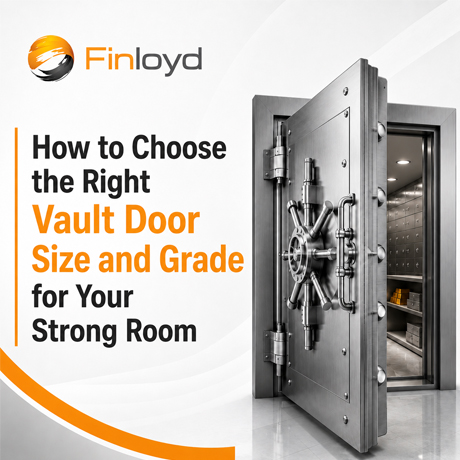
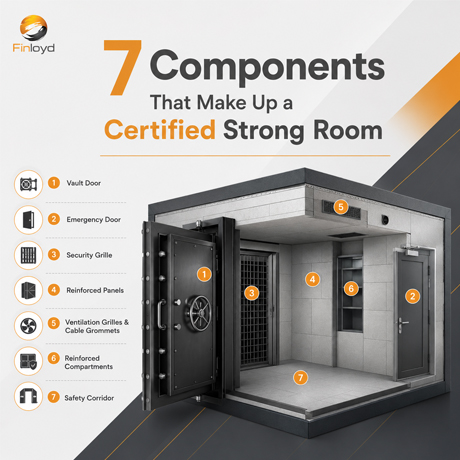
1. Vault Door The vault door is the strong room’s single point of entry, and by regulation it must carry the same resistance grade as the surrounding walls (Grade II–XIII under EN 1143-1). Vault doors accept up to five locks — mechanical or electronic — all certified to EN 1300, the standard governing high-security locks. Latch count and diameter scale with the door’s grade, typically ranging from 7 to 16 latches between 30mm and 60mm in diameter.
2. Emergency Door A smaller secondary door, either built into the main vault door or set into an armored wall panel, used only if the primary door fails while someone is inside. Even as a backup, it must carry at least Grade VII resistance in financial installations — it cannot be the weak point in an otherwise certified enclosure.
3. Security Grille Installed on the interior face of the vault door (or at corridor entrances), the security grille adds a secondary barrier once the main door is open — common practice for daytime operating hours when the vault door itself stays unlocked but access still needs to be controlled.
4. Reinforced Panels Where poured reinforced concrete isn’t practical — upper floors, retrofits, tight footprints common in Riyadh and Jeddah commercial towers — modular armored panels achieve the same certified resistance grade. Panels are welded and interlocked on walls, floor, and ceiling to form a single continuous structure with no weak seams.
5. Ventilation Grilles & Cable Grommets Every strong room needs air circulation and cabling for alarms, cameras, and power — without opening a gap in its resistance rating. Certified ventilation grilles and cable pass-throughs are engineered to preserve the panel’s full grade rating at every penetration point.
6. Reinforced Compartments Internal partitioned units — safe deposit box arrays, individual client lockers — built and certified to their own theft-resistance standard, separate from the outer vault structure. This matters for banks offering safe deposit services in Riyadh, Jeddah, or Al Khobar branches.
7. Safety Corridor An additional wall built ahead of the vault, creating a secured perimeter corridor (typically up to 60cm wide) around the enclosure. This buys extra time and surveillance coverage before an intruder ever reaches the vault wall itself — and is increasingly specified in new-build bank branches across the Kingdom.
EN 1143-1 vs. Other Standards Referenced in Saudi Projects
Most European-manufactured strong room systems supplied into the Saudi market are certified to EN 1143-1 and EN 1300. Some international tenders — particularly those following US-influenced specifications — reference UL 608 (Underwriters Laboratories) instead, which tests similar burglary-resistance criteria using a different methodology and grading scale. When comparing quotations, confirm which standard a vendor’s certification actually covers — EN and UL grades are not directly interchangeable.
New: UL-Certified Vault Doors Coming to the Finloyd Range
Finloyd will soon expand its certified vault door range with a new OEM brand, engineered to meet UL 608, UL 887, and UL 768 — giving Riyadh, Jeddah, and Al Khobar clients a UL-certified option alongside our existing EN 1143-1 range for projects specified under US-influenced tenders.
- UL 608 (Class 2) — the US standard for burglary-resistant vault doors and modular panels. Class 2 requires the door to resist a minimum of one hour of net working time against forced entry using the hand tools, power tools, and cutting torches specified in the standard.
- UL 887 — governs delayed-action timelocks fitted to vault doors, providing a fixed or user-set time delay (from as little as 5 minutes up to 120+ hours) before the door can be opened, as protection against robbery and burglary.
- UL 768 — governs the combination locks used on the boltwork itself, testing resistance to manipulation and unauthorized opening by touch, sound, or sight.
Together, these three certifications cover the door body, the time-delay mechanism, and the combination lock — the same three-part coverage EN 1143-1 and EN 1300 provide on the European side, just tested to US methodology. Once this brand launches, Finloyd will be able to specify either EN- or UL-certified vault doors depending on which standard your tender, insurer, or head office requires.
Specifying a Strong Room for Your Facility
The right combination of these seven components depends on your risk profile, insurer requirements, and whether local regulation sets a minimum grade for your sector. Finloyd works with banks, jewelers, and government facilities in Riyadh, Jeddah, and Al Khobar to design and deliver complete strong room systems — vault door, emergency door, security grilles, reinforced panels, ventilation and cable pass-throughs, reinforced compartments, and safety corridor — matched to the required EN 1143-1 grade. These services are scoped and quoted per project rather than listed as standalone catalog items, so browse our vault door range to start, or request a project consultation and our team will assess which of the seven components your facility needs.
FAQ
What is the minimum EN 1143-1 grade required for a bank vault? Most financial institutions require a minimum of Grade VII under EN 1143-1 for cash and valuables storage, though the exact requirement depends on local regulation and insurer policy.
Can a strong room be built without poured concrete? Yes. Modular reinforced/armored panels achieve the same certified resistance grades as poured concrete and are commonly used for retrofits or upper-floor installations where wet construction isn’t practical.
Is EN 1143-1 the same as UL 608? No. Both test burglary resistance but use different methodologies, tools, and grading scales. A strong room certified to one standard is not automatically equivalent under the other — always verify which certification a quoted system actually carries.
Will Finloyd offer UL-certified vault doors? Yes. Finloyd will soon launch an OEM vault door brand certified to UL 608 (Class 2), UL 887, and UL 768, giving clients the option of a UL-certified system alongside our existing EN 1143-1 range.
Do safe deposit boxes need separate certification from the vault itself? Yes. Reinforced compartments and safe deposit box arrays are certified against theft under their own standard, independent of the outer vault structure’s EN 1143-1 grade.
How long does a certified strong room take to install in Saudi Arabia? Timelines depend on whether the project uses poured reinforced concrete (longer, due to curing time) or prefabricated armored panels (faster, days rather than weeks). Finloyd can advise on the right method during project consultation.