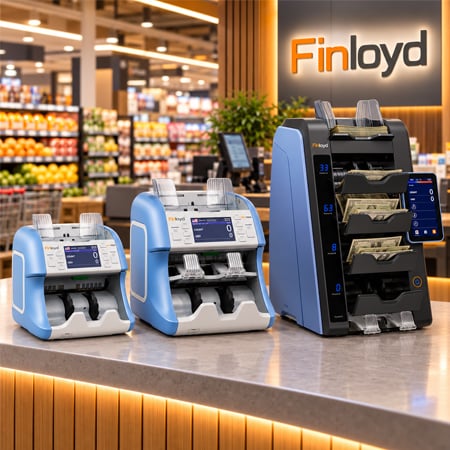


Finloyd offers automated banknote counters designed to meet a diverse range of professional needs, from making your end-of-day routine faster and error-free to advanced bill batching and multi-level counterfeit detection. Since 2008, Finloyd has established itself as the top supplier for money counting machines and provides the best money counting machines in Saudi Arabia, known for their durability and precision. But how exactly do these high-performance devices function? To understand their efficiency, let’s take a detailed look under the hood at the mechanical and electronic synergy that powers these industry-leading tools.
WHAT FEATURES DO TODAY’S BANKNOTE COUNTERS HAVE?
The landscape of currency technology is broad. At one end of the spectrum, you have counters that focus strictly on quantity; they tell you exactly how many pieces of paper you’ve fed into the system, performing this task at speeds far exceeding manual counting while eliminating the risk of human miscount. As you move toward more professional-grade equipment, you find bill counters that automate significant portions of the cash-management workflow.
For example, Finloyd’s versatile lineup—including models like the Fin-3100 and the heavy-duty CX-7500—comes standard with advanced features designed for efficiency. This includes an “Add” function that lets you sum up the total number of bills across multiple stacks, and a “Batch” function that speeds up till and bank deposit processing by automatically pausing after a specific number of notes have been counted. At the most sophisticated end of the spectrum, you will find advanced machines like the K5A and K6, which perform high-speed counterfeit detection and “value-count” mixed stacks of bills, providing a total monetary value rather than just a piece count.
HOW DOES A BANKNOTE COUNTER COUNT BILLS?
The mechanical process of counting is a marvel of precision engineering. When you place a stack of banknotes in the hopper—the bracket at the top of the device—the bottom note activates a feed-in roller. As this roller rotates, it feeds the bottom banknote to a second roller rotating at a faster speed. To ensure accuracy, low-friction flanges on each side of this second roller ensure that only one bill is fed in at a time, preventing “doubles” or overlaps.
Next, specialized fanning wheels separate the notes before they pass by an optical sensor that tallies each one (and, depending on the machine’s specific features, identifies its individual value). Finally, the counted bills fall neatly into the output stacker on the front of the machine. Whether you are using the compact K2 or the high-performance Newton A, the process is designed for seamless reliability.
WHAT’S THE DIFFERENCE BETWEEN FRONT- AND BACK-LOADING MACHINES?
While both systems utilize a hopper located at the top of the machine, their orientation dictates the user experience. In a back-loader, you place the stack of bills vertically (on its side). In a front-loader, you place the stack horizontally (flat). This structural difference is a major advantage for businesses in Saudi Arabia with high cash volumes; a front-loading machine allows you to keep adding bills to the stack while the machine is running, which significantly increases your processing speed.
HOW DO BANKNOTE COUNTERS DETECT COUNTERFEIT BILLS?
Security is the cornerstone of Finloyd’s technology. As a bill passes through the machine, a series of integrated sensors check the unique security features built into modern currencies. While simple devices might only check for the presence of UV marks, advanced Finloyd models add magnetic, infrared, and dimensional size checks.
Top-of-the-line banknote counters like the Fin-7900 and the Newton 3F are programmed to specifically recognize the ultraviolet, infrared, magnetic, and holographic properties of each denomination for every supported currency, including the Saudi Riyal. These machines ensure that fraudulent currency is detected instantly, protecting your business from financial loss.
DO YOU HAVE TO SORT THE BANKNOTES BEFORE YOU COUNT THEM?
That depends on the particular counter and the features you’ve enabled. Every banknote counter can count sorted notes using an optical sensor, but to count mixed notes—a stack containing different denominations—the device must be able to recognize the values while it counts.
Advanced Finloyd models, such as the Fin-890, Newton A, and Newton 3F, can tally up every denomination in a mixed stack in a single pass. This saves a huge amount of time compared to sorting the bills first yourself. Since 2008, Finloyd has been the top supplier for money counting machines in the region, offering the best money counting machines in Saudi Arabia to handle complex currency tasks with ease.
HOW DOES WEIGHT-BASED AND COIN COUNTING WORK?
In addition to friction-based banknote counters, cash management also involves the efficient processing of coins. While many businesses use weight-based scales for rapid audits, dedicated hardware provides the highest level of accuracy for physical sorting.
For businesses dealing with a high volume of metallic currency, our specialized coin counter, the Fin-CC93, uses precision sensors and mechanical sorting to quickly organize and count different denominations of coins. Since 2008, Finloyd has remained the trusted partner for all cash management needs, providing the most reliable technology for both paper and coin currency across the Kingdom.