
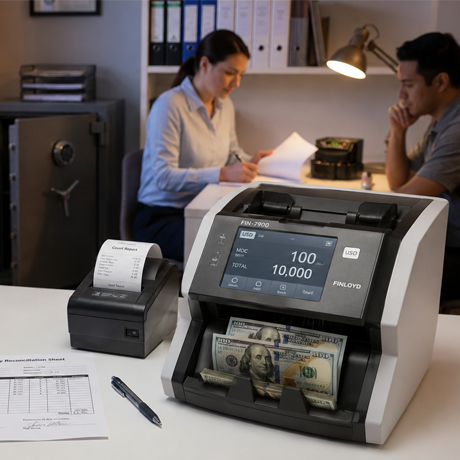
End-of-day reconciliation is where your cash numbers either prove out or fall apart. It is the single process that connects what your register says happened to what is physically in the drawer — and most businesses treat it as a chore their closers rush through at the tail end of a long shift.
By FinloydMoney counting machine supplier · Saudi Arabia since 2008Riyadh · Jeddah · Al Khobar
That rushed approach is exactly how variances go unlogged, how discrepancies stack up without explanation, and how nobody can trace where the money went when someone finally notices, three weeks later, that the totals don’t add up. By the time a problem is visible in the monthly accounts, the shift it came from is long gone, the staff who worked it have moved on to a dozen other tasks, and the camera footage may already be overwritten.
A repeatable reconciliation process — built around verified counts, printed documentation, and a consistent routine — turns closing from a nightly gamble into a system that produces defensible numbers every time. It does not require perfect employees or expensive software. It requires a fixed sequence, the right counting equipment, and the discipline to run it the same way every night.
As Finloyd — the top supplier of money counting machines in Saudi Arabia since 2008 — we have equipped retailers, restaurants, money exchanges, pharmacies, and high-volume cash businesses across Riyadh, Jeddah, and Al Khobar with the bill counters, coin counters, and counterfeit detectors that make this routine fast and trustworthy. This guide lays out how to manage cash efficiently, reduce mistakes, and protect every riyal in your drawer.
What this guide covers
- What cash reconciliation is
- Setting up your closing procedure
- Counting the drawer, step by step
- Compare, document, investigate
- Print the receipt, sign the sheet
- Prepping the deposit
- Tracking variances over time
- Common mistakes to avoid
- Choosing the right machine
- FAQ & key takeaways
01What Cash Reconciliation Is (And Why It Matters)
Cash reconciliation is a comparison between two numbers: the cash your POS system shows you should have in the drawer (the expected total) and the cash you actually count (the physical total). Everything else in the process — the procedure, the equipment, the paperwork — exists to make that comparison accurate and provable.
The difference between those two numbers is your variance. A zero variance means the drawer balances perfectly. A positive variance means you have more cash than expected (an overage). A negative variance means you have less (a shortage). Either direction means something happened during the shift that needs an explanation — a balanced drawer is the only outcome that needs none.
Variance = Expected − CountedRegister 03 · Evening
POS Expected − Counted Total = Variance
BalancedSAR 0.00 · clean
Overage+ SAR 14.50 · investigate
Shortage− SAR 23.00 · escalate
This isn’t just bookkeeping. Reconciliation is your earliest warning signal for transaction errors, pricing issues, register mistakes, counterfeit bills, and theft. A drawer that is consistently a little short might be a mispriced item rung up dozens of times a day; a sudden large overage might be a refund processed in the POS while the cash stayed in the till. If you’re not reconciling every register every night, you’re operating in the dark until the problem becomes obvious — and by then it’s usually too late to trace it back to a shift, a transaction, or a person.
02Before You Count: Set Up Your Closing Procedure
Reconciliation quality is determined before anyone touches a bill. The count is only as reliable as the conditions you count under, so the setup matters as much as the arithmetic.
Standardize starting drawer amounts
Every register should open every shift with the same predetermined cash amount — SAR 200, SAR 300, whatever denomination mix fits your business. This gives you a known baseline to subtract at close. If the starting amount varies by register, or by whoever happened to open that day, your closing math is unreliable before it even begins, because you no longer know how much of the drawer was float and how much was sales.
Pull the POS report first
Before you count a single bill, print or pull the expected cash total from your POS system. You need to know the target number before the count, not after. Counting first and then checking the POS creates a quiet temptation to “make it work” — to recount until the number lands where you expect it — rather than to document the real variance the first time. The expected total should be locked in writing before the drawer is opened.
Secure the environment
Count in a back office, break room, or any space with a locked door and camera coverage. Counting cash on the sales floor — or anywhere accessible to non-counting staff — introduces variables you can’t control and weakens any later investigation. A consistent, monitored counting location is also what an auditor or insurer will expect to see.
Use two people, always
Dual-custody counting means two unrelated employees are present for every count. One counts, the other observes and verifies, and both sign the reconciliation sheet. This deters theft and, just as importantly, protects honest employees from false accusations — no one is ever the sole person who can account for a drawer.
Stage your tools
Have everything ready before starting: a bill counter, coin-sorting equipment, deposit bags, blank reconciliation sheets, and a pen. Hunting for supplies mid-count wastes time, breaks focus, and tempts people to shortcut the procedure. A fixed counting station with the equipment permanently set up removes that friction entirely.
Finloyd tip: A dedicated counting station — bill counter, coin counter, and counterfeit detector kept together in a secured room — pays for itself in the first month through faster closes and fewer disputed counts. Talk to us about a setup sized to your nightly volume.
03Step-by-Step: Counting the Drawer
Once the register is closed out and the POS report is pulled, the physical count follows a specific sequence. Running it in the same order every night is what makes the result repeatable.
- Remove the starting drawer amount first. Count out your standard opening amount and set it aside — this cash is returned to the register for tomorrow’s opening. Everything that remains is what you reconcile against the POS-expected total. Skipping this step is one of the most common reasons drawers show a false overage.
- Count the bills. If your team sorts by denomination before counting, run each stack through the counter separately. A value-count mode gives you both the bill count and the dollar total for each denomination, so your reconciliation sheet fills itself in. If your team counts unsorted drawers, a mixed-denomination bill counter accepts the entire drawer as-is and returns a complete breakdown of every denomination in a single pass.
- Count the coins. For small coin volumes, hand-counting is fine. For businesses that accumulate meaningful coin totals — restaurants making change, laundromats, arcades, car washes — a coin counter and sorter saves real time and eliminates the slow, error-prone denomination-by-denomination manual sort.
- Account for non-cash tenders. Checks, credit-card batch totals, gift-card redemptions, and any other non-cash payments recorded in the POS reduce the amount of physical cash you should expect in the drawer. Add these to your reconciliation sheet so the comparison is apples-to-apples and a card-heavy night doesn’t look like a shortage.
- Record the final counted total. Bills plus coins plus non-cash tenders equals your total reconciled amount. This is the single number you compare to the POS-expected total.
04Reconciling: Compare, Document, Investigate
With the POS expected total and the counted total side by side, the math is simple: expected minus counted equals variance. What you do with that variance is where reconciliation actually earns its keep.
Zero variance
The drawer balances. Document it — even a zero variance is worth recording — and move on to deposit prep. The signed, clean sheet is part of the paper trail that proves your process is running every night, not only on the nights something went wrong.
Positive variance (overage)
You have more cash than expected. This could mean a customer was overcharged, a refund was processed in the POS but the cash was never handed back, or a transaction was entered at the wrong amount. Overages aren’t “good” — they indicate an error somewhere in the shift, and an unexplained overage is as much a red flag as a shortage. Log the amount and note any possible explanation while the shift is still fresh in memory.
Negative variance (shortage)
You have less cash than expected. This is the one that gets attention. Possible causes include a genuine miscount (recount before investigating further), an incorrectly entered transaction in the POS, a discount or void that wasn’t recorded, a counterfeit bill that reduced the drawer’s actual value, or theft. If you’re hand-counting, start by running the cash through a bill counter to verify the total with machine accuracy — a surprising number of “shortages” are simply human miscounts — then escalate only if the machine confirms it.
Document every variance, regardless of size. Date, register number, shift, amount, direction (over or short), who counted, and any notes on possible cause. Small variances that seem harmless in isolation reveal patterns when tracked over time — and patterns are the whole point.
05Print the Receipt, Sign the Sheet
The printed count receipt from your bill counter serves as the anchor for your reconciliation documentation. It provides a machine-verified total, a denomination breakdown, and a timestamp that no handwritten note can replicate — and that no one can quietly adjust after the fact.
Attach that receipt to a reconciliation sheet that includes: the date, register number, starting drawer amount, POS expected total, counted total, variance amount and direction, non-cash tender totals, and the names and signatures of both counters. Together they form a complete, self-contained record of the night.
This is the paper trail that ties your register activity to your physical cash to your bank deposit. Without it, you have a number someone wrote on a notepad — which proves nothing in an audit, a theft investigation, an employee dispute, or a bank inquiry. With it, every riyal has a documented path from the till to the deposit slip.
Finloyd hardware: The Finloyd Cash Handling Printer pairs with most Finloyd bill counters to generate these receipts automatically — a denomination breakdown and timestamped total printed at the end of every count. Businesses that don’t yet use a printer can photograph the counter’s display after each count to create a record far more reliable than a handwritten total.
06Prep the Deposit
With reconciliation complete and documented, the remaining cash gets prepped for the bank. A clean reconciliation flows straight into a clean deposit.
- Sort and strap bills. If your counter has a batch mode, set it to standard strap quantities (typically 100 bills) and let the machine stop automatically at each bundle, eliminating manual counting during deposit prep. For mixed-denomination counters, the machine has already sorted by denomination, so your bills come out organized and ready to strap.
- Roll or bag coins. Follow your bank’s requirements. Some accept loose coins with a verified count slip; others require rolled coins. Coin counters with a batch mode stop at standard roll quantities for each denomination, making the process automatic.
- Match the deposit slip to the reconciliation sheet. The total on your deposit slip should equal the counted total on your reconciliation sheet minus any cash retained for tomorrow’s starting drawers. If these numbers don’t match, find out why before you seal the deposit bag — not after.
- Deposit promptly. Cash sitting in your safe is cash at risk. Deposit the next business day at the latest; high-volume businesses should deposit daily. Don’t let a weekend’s worth of cash accumulate in the safe if you can avoid it.
07Track Variances Over Time
A single SAR 5 shortage is noise. A SAR 5 shortage on Register 3 every Thursday is a signal. The difference between the two is only visible if you keep the data.
Keep a running variance log — a simple spreadsheet with columns for date, register, shift, variance amount, direction, who counted, and notes. Review it weekly or monthly and look for patterns rather than reacting to individual nights.
- Same register, recurring shortage: could be a mechanical issue with the register, a POS configuration error, or a pricing problem on a frequently sold item.
- Same shift or same employee, recurring shortage: could be a training issue (transaction-entry errors) or something that warrants a closer, quieter look.
- Random, small variances across all registers: likely normal operational noise — minor transaction errors, rounding, customers leaving change behind. Document and monitor, but don’t panic.
- Sudden large variance with no explanation: investigate immediately. Recount the cash with a bill counter for machine-verified accuracy, review POS transaction logs for voids, refunds, or unusual activity, and check camera footage from the counting area while it still exists.
This log is also exactly what auditors and accountants want to see. It demonstrates that your business actively monitors cash handling rather than discovering problems after the fact — which strengthens your position in every audit, insurance claim, and dispute.
08Common Reconciliation Mistakes (And How to Avoid Them)
Most reconciliation failures aren’t dramatic — they’re small, repeated habits that quietly corrupt the data. Here are the ones to watch for.
- Counting before pulling the POS report. If you don’t know the expected total before you count, there’s no real reconciliation happening — just counting. Always pull the target number first.
- Forgetting to remove the starting drawer. This inflates your counted total and creates a false overage that masks real variances. Remove and set aside the opening amount before counting anything else.
- Single-person counts. One person counting alone means one person’s word is the only record. Dual-custody isn’t optional if you want numbers you can defend.
- Rounding or ignoring small variances. Writing “SAR 0” on the sheet when the actual variance was −SAR 8.40 defeats the purpose. Log the real number every time — patterns only emerge from accurate data.
- Not documenting zero-variance nights. A clean count still gets a signed sheet and a printed receipt. Consistent documentation is what makes the process trustworthy over time, not just on the nights something goes wrong.
- Counting fatigued. End-of-shift manual counting combines the worst conditions for accuracy: tired employees, repetitive work, and pressure to go home. A bill counter removes human fatigue from the equation entirely — the machine doesn’t care what time it is.
- Missing counterfeits in the recount. If a drawer comes up short and you recount by hand, you’ll get the same wrong number twice. A counterfeit bill creates a phantom shortage that no recount will resolve. Bill counters with built-in counterfeit detection (UV, MG, IR) catch fakes during the count, and a standalone counterfeit detector at the register stops them from entering the drawer in the first place.
09Choosing the Right Money Counting Machine
The right counter depends on how much cash you handle, how mixed your drawers are, and how strict your documentation needs to be. Reconciliation gets faster and far more trustworthy when the machine matches the workload — and slower and more frustrating when it doesn’t.
Match the machine to your volume
- Single-denomination bill counters suit businesses that pre-sort by denomination and want a fast, accurate count of each stack with a per-denomination value total.
- Mixed-denomination money counting machines read a full, unsorted drawer in one pass and return a complete breakdown — ideal for busy retail, restaurants, and money exchanges where pre-sorting wastes time.
- Coin counters and sorters handle the change-heavy operations — laundromats, arcades, car washes, cafeterias — where coins would otherwise eat half the closing time.
- Counterfeit detectors with UV, MG, and IR verification catch fakes at the register and during the count, protecting both your deposit and your variance data.
Don’t overlook documentation
A counter that prints — or pairs with a cash-handling printer — turns every count into a timestamped, machine-verified record. For any business that reconciles seriously, that printed receipt is not an accessory; it is the foundation of the paper trail described above.
Need help choosing? Finloyd has matched thousands of Saudi businesses to the right bill counter, coin counter, and counterfeit detector since 2008. Tell us your nightly volume and drawer style, and we’ll recommend a setup that closes clean in 10–15 minutes per register.
Saudi Arabia · Since 2008
Finloyd — the top supplier of money counting machines in Saudi Arabia
Since 2008, Finloyd has equipped retailers, restaurants, money exchanges, pharmacies, and high-volume cash operations across the Kingdom with bill counters, coin counters, counterfeit detectors, and cash-handling printers — backed by branches in Riyadh, Jeddah, and Al Khobar. Whether you’re building a reconciliation routine from scratch or upgrading an aging counter, our team will help you choose equipment sized to your volume and your documentation standards.
📞 +966 50 844 0075✉️ [email protected]🌐 finloyd.com
FAQFrequently Asked Questions
How long should end-of-day reconciliation take?
With a bill counter and a structured procedure, reconciliation for a single register should take 10–15 minutes — including the count, POS comparison, documentation, and deposit prep. Manual counting stretches that to 30–45 minutes or more, especially when recounts are needed. Multi-register businesses should budget accordingly, though counting multiple drawers becomes faster once the process is routine.
What’s an acceptable cash variance?
There’s no universal threshold, but most well-run cash businesses treat roughly ±SAR 5 to ±SAR 10 per register per day as within normal operational range. Variances consistently above that suggest a procedural or personnel issue. Some businesses set tighter tolerances — for example ±SAR 2 — in high-accountability environments. The important thing isn’t the threshold itself; it’s that you set one, document every variance, and investigate when the pattern exceeds it.
Should I reconcile every register separately?
Yes. Combining multiple drawers into a single count masks the register the variance came from. If Register 1 is SAR 40 over and Register 2 is SAR 40 short, a combined count shows zero variance — and you’ve missed two problems that cancel each other out. Count each drawer individually, document each on its own reconciliation sheet, and track variances per register.
What do I do if the count doesn’t match after two attempts?
If two machine-verified counts produce the same number and it still doesn’t match the POS expected total, the issue is almost certainly not a counting error. Review the POS transaction log for voids, refunds, discounts, or incorrectly entered amounts. Confirm that non-cash tenders were properly accounted for and that the starting drawer amount was correct. If the variance remains unexplained, document it with full detail in the variance log and flag it for management review.
Do I need a bill counter for reconciliation, or can I count by hand?
You can hand-count, but the trade-offs are significant. Manual counting takes 3–5 times longer, produces no printed verification, and carries a 1–3% error rate that makes your variance data hard to trust. A bill counter provides a machine-verified total within minutes, along with a printed receipt that independently documents the count. For any business handling more than a few hundred riyals per night, the accuracy, speed, and documentation more than justify the investment.
Where can I buy a money counting machine in Saudi Arabia?
Finloyd has supplied money counting machines, bill counters, coin counters, and counterfeit detectors across Saudi Arabia since 2008, with branches in Riyadh, Jeddah, and Al Khobar. Call +966 50 844 0075 or email [email protected] for product selection and pricing.
★Key Takeaways
End-of-day reconciliation is the process that turns your daily cash flow from a guess into a verified number. Done right, it takes 10–15 minutes per register, produces a signed and printed record of every count, and gives you an early-warning system for errors, counterfeits, and theft.
The fundamentals are simple: pull the POS report first, remove the starting drawer, count with a machine, compare the totals, document the variance, print the receipt, sign the sheet, and prep the deposit. Do it the same way, in the same order, every single night.
Track your variances over time — patterns in the data tell you things individual counts never will. And build the paper trail of reconciliation sheets, count receipts, deposit slips, and variance logs that connects your register to your safe to your bank statement without a single gap.
The businesses that close clean every night aren’t the ones with perfect employees or perfect systems. They’re the ones with a repeatable process — and the discipline to follow it. Finloyd supplies the equipment that makes that discipline easy.
Finloyd · Money counting machines & cash-handling equipment · Saudi Arabia since 2008 · Riyadh · Jeddah · Al Khobar
📞 +966 50 844 0075 · ✉️ [email protected] · 🌐 finloyd.com