
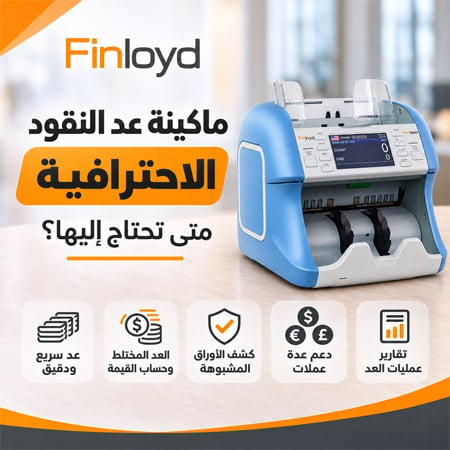
Quick answer: A professional money counting machine is one that totals, checks and separates notes so the operator never has to stop and sort by hand. In practice that means one of four steps up from a basic sheet counter: a value counter that totals mixed notes (CX-7500, Fin-7900), a 1+1 machine with a reject pocket that never stops for a suspect note (Kisan K2), a multi-pocket fitness sorter that separates notes by denomination and condition (Kisan K5-A), or a sorting and strapping system that bands finished bundles (Kisan K6). You need one when counting, re-sorting or re-counting is taking staff time every day.
What makes a money counter “professional”?
Speed alone does not. Most basic counters already run at 1,000 notes per minute or more. What slows a team down is the machine stopping: for a suspect note, a different denomination, a folded note or a foreign currency. Each stop means removing the note, re-sorting and often re-counting the batch.
A professional machine removes those stops in three ways:
- It knows denominations: it reads each note and gives the total value of a mixed stack, so nobody sorts by hand first.
- It has somewhere to put problems: a reject pocket catches suspect, foreign or damaged notes while the rest keep counting.
- It separates as it counts: multi-pocket sorters split notes by denomination, by condition (fit or unfit) and by facing, ready for the bank.
The 5 tiers, from basic to cash centre
| Tier | Type | What it does | Finloyd models | Typical user |
|---|---|---|---|---|
| 1 | Sheet counter (basic) | Counts pieces of sorted notes, checks UV and magnetic features, stops at suspect notes | Fin-890, Fin-3100 | Small shops, cafés |
| 2 | Value counter | Totals mixed denominations in one pass; some read serial numbers | CX-7500, Fin-7900, Newton-A | Restaurants, pharmacies, supermarkets |
| 3 | 1+1 counter with reject pocket | Diverts suspect and foreign notes to a second pocket without stopping | Kisan K2 | Head offices, fuel station chains, exchange counters |
| 4 | Multi-pocket fitness sorter | Sorts by denomination, condition and facing into several pockets | Kisan K5-A (4+1), Glory GFS-220F, Hitachi iH-110 | Bank branches, exchange houses, cash-in-transit |
| 5 | Sorting and strapping system | Sorts and automatically bands bundles of notes | Kisan K6 | Bank cash centres, large cash processors |
Tiers 2 to 5 are what the market calls professional. Tier 1 is the right tool for many small businesses and is not a lesser choice if your cash is already sorted.
The three features that matter most
Mixed-value counting (tier 2 and up)
Put in a till of 500s, 100s, 50s and 10s, and the machine shows the count and value of each denomination and the grand total. The CX-7500 does this at 1,200 notes per minute for riyals, dollars and euros; the Fin-7900 adds serial number reading, which settles disputed counts.
Reject pocket (tier 3 and up)
On a 1+1 machine such as the Kisan K2, suspect, foreign or damaged notes drop into a second pocket while the batch keeps running. For a head office counting dozens of branch bags, that removes most of the stops in the day.
Fitness sorting (tier 4 and up)
A fitness sorter checks each note’s condition, separating worn, torn, soiled or taped notes from notes fit to reuse. Banks and exchange houses need this to recirculate good notes and return unfit ones. The Kisan K5-A is a desktop 4+1 pocket fitness sorter; the Kisan K6 adds automatic banding for cash centres.
8 signs you have outgrown your counter
- Staff sort notes by denomination by hand before counting.
- The machine stops several times per batch for suspect or odd notes.
- You re-count batches because a stop broke the count.
- Cashiers or branches dispute totals and you cannot prove what was counted.
- Counting runs more than an hour a day or across several shifts.
- You count cash from several branches, tills or drivers in one place.
- You handle riyals, dollars and euros in the same day.
- Your bank returns notes as unfit, or you need to separate fit and unfit notes yourself.
One or two signs usually point to a value counter (tier 2). Signs 2, 3 and 6 point to a 1+1 machine (tier 3). Sign 8 means a fitness sorter (tier 4).
Which tier for which business?
| Business | Start at |
|---|---|
| Small shop or café, sorted cash | Tier 1: Fin-890 |
| Restaurant, pharmacy, supermarket with mixed tills | Tier 2: CX-7500 or Fin-7900 |
| Fuel station chain or restaurant group head office | Tier 3: Kisan K2 |
| Exchange house or busy cash office | Tier 3 or 4: Kisan K2 or K5-A |
| Bank branch or cash-in-transit depot | Tier 4: Kisan K5-A, Glory or Hitachi |
| Bank cash centre | Tier 5: Kisan K6 |
For sector guides, see our posts on restaurants, pharmacies and gas stations, or the full money counting machine comparison.
What professional machines still need from you
- Cleaning: dust and paper fibre on the sensors cause false rejects; clean weekly on busy machines.
- Updates: when a new note series is issued, the machine needs a software update to recognise it.
- Hand checks: a rejected note means “check this”, not “this is fake”. Check it against the security features published by the Saudi Central Bank (SAMA).
- Service: sorters have more moving parts; choose a supplier with local technicians and spare parts.
Supply and service in Saudi Arabia
Finloyd has supplied money counting machines in Saudi Arabia since 2008 and is the authorized distributor of Kisan counters and sorters in the Kingdom. Our teams in Riyadh, Jeddah and Al Khobar install, train staff, update machines for new notes and provide door-to-door maintenance.
Frequently asked questions
What is a professional money counting machine?
A machine that totals, checks and separates notes so the operator does not have to stop and sort by hand: a value counter, a 1+1 counter with a reject pocket, a multi-pocket fitness sorter, or a sorting and strapping system.
What is the difference between a money counter and a money sorter?
A counter counts notes and may total their value. A sorter also separates them into several pockets by denomination, condition or facing. Sorters are used by banks, exchange houses and cash centres.
What is a 1+1 money counter?
A counter with two pockets: the main stacker for good notes and a reject pocket for suspect, foreign or damaged notes, so counting does not stop. The Kisan K2 is a 1+1 machine.
What is fitness sorting?
Checking each note’s condition and separating worn, torn, soiled or taped notes from notes fit to reuse. Banks and exchange houses use fitness sorters such as the Kisan K5-A.
Is a faster money counter more professional?
Not by itself. Most counters exceed 1,000 notes per minute. What saves time is fewer stops: mixed-value counting, a reject pocket and multi-pocket sorting.
Does a small shop need a professional counter?
Usually not. If cash is sorted and volumes are low, a sheet counter such as the Fin-890 is enough. Move to a value counter when you start counting mixed tills.
Do professional counters detect counterfeit riyals?
They check machine-readable security features using UV, magnetic, infrared and image sensors, and divert suspect notes. Always check rejected notes by hand against SAMA’s published security features.
Where can I buy a professional money counting machine in Saudi Arabia?
Finloyd supplies, installs and services Kisan, Glory and Hitachi counters and sorters from Riyadh, Jeddah and Al Khobar. Call Jeddah +966 50 844 0075, Riyadh +966 50 003 2928 or Al Khobar +966 55 721 2191.
Not sure which tier you need? Tell us how much cash you count each day, in how many places, and what you do with it afterwards, and we will recommend the machine. See all money counting machines.