
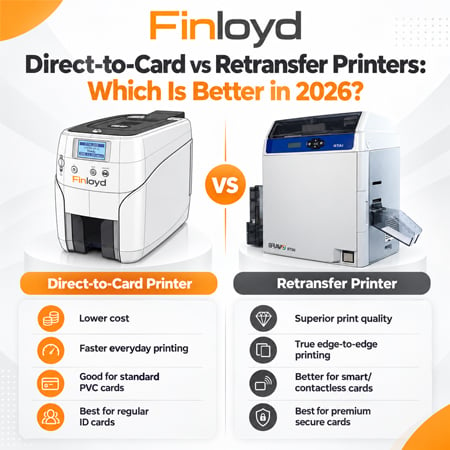
Quick answer: A direct-to-card (DTC) printer prints straight onto the card: it is faster and cheaper per card, and right for most staff, student and membership cards. A retransfer printer prints onto a clear film and fuses it to the card: it gives sharper, over-the-edge, more durable cards and handles smart cards and special materials. At Finloyd, the Fin-CP is the best-value DTC printer for everyday issuing, the Evolis Primacy 2 is the DTC choice for high volume and built-in security, and the Bravo RTAI is the 600 dpi retransfer printer for government, university and high-security cards.
The print method is the first decision when you buy a card printer, before brand or price. Get it right and every card looks the way it should for years. Get it wrong and you either overpay for quality nobody needs, or issue cards that fade, peel or print badly over a chip.
How direct-to-card printing works
A thermal print head presses a colour ribbon onto the card. Heat turns the dye into gas, which sinks into the PVC surface (dye sublimation), then a clear overlay panel seals it. The print head touches every card. It is fast, simple and economical, and works best on flat PVC cards.
How retransfer printing works
The print head prints the image in reverse onto a clear film. A heated roller then fuses that film onto the card. The print head never touches the card, so the image goes over the edge, sits under a protective layer, and is not affected by the slight bump of a chip or antenna. Retransfer also accepts materials a DTC head cannot, and opens up holographic and metallic security effects.
DTC vs retransfer at a glance
| Direct-to-card | Retransfer | |
|---|---|---|
| How it prints | Print head on the card | Print on film, film fused to card |
| Typical resolution | 300 dpi | Up to 600 dpi |
| Coverage | Edge to edge on flat PVC | Over the edge, any surface |
| Smart and proximity cards | Possible; chip area can print less evenly | Ideal; no contact with chip or antenna |
| Durability | Good, with overlay | Higher; image protected under film |
| Speed | Faster | Slower per card |
| Cost per card | Lower (ribbon only) | Higher (ribbon plus film) |
| Best for | Staff, student, membership, visitor cards | Government, university, bank and high-security cards |
Fin-CP vs Primacy 2 vs Bravo RTAI
| Spec | Fin-CP | Evolis Primacy 2 | Bravo RTAI |
|---|---|---|---|
| Print method | Direct-to-card | Direct-to-card | Retransfer |
| Resolution | 300 dpi, Japanese print head | 300 dpi (up to 300×1200 mono) | 600 dpi |
| Colour speed | 180–200 cards/hour | Up to 280 cards/hour single-sided; 170 dual | About 144 cards/hour single-sided (25 s/card); 55 s dual |
| Monochrome speed | 800 cards/hour | – | – |
| Sides | Single; dual as a factory upgrade | Single or dual | Single or dual, over the edge |
| Input / output | 100 / 60 | 100 or 200 feeder | 250, add cards while printing; reject tray |
| Encoding | Magnetic, contact (EMV L1), contactless MIFARE / DESFire / NFC (factory options) | Magnetic, contact, contactless | Ask Finloyd |
| Security options | Coloured and metallic gold ribbons | UV printing, double overlay, lamination, Kineclipse data scrambling, key lock | Holographic film, HOLO-MET metallic ribbons, gold and silver, tactile print, feeder lock |
| Card materials | PVC | PVC, rewritable cards | PVC, ABS, PET, PET-G, PC, translucent, wooden; 0.5–1.0 mm |
| Warranty | 2 years printer and print head | 3 years print head | 3 years printer, lifetime print head |
| Best for | Offices, schools, hospitals, gyms | Medium-to-large volume, HR, universities, government | 30,000+ cards/year, national, university and high-security IDs |
Fin-CP: the best-value everyday printer
The Fin-CP is Finloyd’s own-brand DTC printer, built for organisations that issue cards as part of a normal working day. It prints edge to edge at 300 dpi with a Japanese print head, produces 180 to 200 colour cards or 800 monochrome cards per hour, and holds 100 cards. Encoding (magnetic, contact chip and contactless MIFARE, DESFire and NFC) and dual-sided printing are factory upgrades, and the Duplex FIN-CP Kit adds two-sided printing. Ribbons include YMCKO, YMCKOK and single-colour white, gold, blue and red. It carries a 2-year warranty on printer and print head, and genuine FIN-CP ribbons are stocked in Riyadh, Jeddah and Al Khobar.
Evolis Primacy 2: high-volume DTC with real security
The Evolis Primacy 2 is one of the fastest DTC printers available: up to 280 single-sided colour cards per hour, 170 dual-sided, and 215 with the lamination module. Its 200-card feeder suits batch printing. It goes beyond basic DTC with UV-effect printing, a double-layer overlay, lamination, Kineclipse data scrambling and a key lock, plus rewritable card support. It runs on Windows, Mac and Linux and prints from phones and tablets, and the print head has a 3-year warranty.
Bravo RTAI: 600 dpi retransfer for high-security cards
The Bravo RTAI is a retransfer printer at 600 dpi, twice the resolution of the DTC models, with over-the-edge printing on one or both sides. It is built for programmes issuing more than 30,000 cards a year. Its security toolkit is wide: a 0.7 mil patch film that gives long card life without a separate lamination module, holographic retransfer film (standard or custom), HOLO-MET metallic-lustre ribbons, gold and silver ribbons, and inline tactile printing you can feel. It accepts PVC, ABS, PET, PET-G, polycarbonate, translucent and specially treated wooden cards from 0.5 to 1.0 mm. The 250-card hopper can be topped up while printing, and the warranty is 3 years on the printer and lifetime on the print head.
Which one should you buy?
| Your situation | Choose | Why |
|---|---|---|
| School, clinic, gym or office printing photo IDs | Fin-CP | Best value, fast, encoding when you need it |
| HR or university printing thousands of dual-sided cards | Evolis Primacy 2 | 280 cards/hour, 200-card feeder, lamination |
| Cards that need visible security (UV, overlay, scrambled data) | Evolis Primacy 2 | Security built into a DTC workflow |
| Smart or access cards with chips or antennas | Bravo RTAI | Retransfer prints evenly over the chip |
| Government, national or high-security IDs | Bravo RTAI | 600 dpi, holographic film, metallic and tactile effects |
| PET, polycarbonate, translucent or wooden cards | Bravo RTAI | Only retransfer handles these materials |
Bilingual Arabic and English cards
All three printers print whatever the design software sends, so Arabic names are a software question. Use badge software that handles Arabic right-to-left text, such as ID-ALL, and set up bilingual templates once. Finloyd can do this during installation.
Supply, installation and service in Saudi Arabia
Finloyd has supplied card printers in Saudi Arabia since 2008 and is an authorized Evolis supplier. Our teams in Riyadh, Jeddah and Al Khobar install the printers, set up encoding and card templates, train your staff, and stock ribbons, films and PVC cards locally. Comparing HID Fargo models too? Read our HID Fargo comparison.
Frequently asked questions
What is the difference between direct-to-card and retransfer printing?
Direct-to-card prints straight onto the card with the print head touching it. Retransfer prints onto a clear film first and fuses the film to the card, giving over-the-edge, more durable printing that works on smart cards and special materials.
Is retransfer worth the extra cost?
Yes if you print smart or access cards, need 600 dpi or holographic security, or need cards to last for years. For standard PVC staff and student cards, a DTC printer such as the Fin-CP or Primacy 2 is the better value.
Fin-CP or Primacy 2: which should I buy?
The Fin-CP is the best value for everyday issuing at 180–200 colour cards per hour. The Primacy 2 suits higher volume (up to 280 cards per hour) and adds UV printing, lamination and data scrambling.
Why choose the Bravo RTAI?
For high-security or high-volume cards: 600 dpi retransfer, over-the-edge printing, holographic film, metallic and tactile effects, and support for PET, polycarbonate, translucent and wooden cards. It is built for more than 30,000 cards a year.
Can a direct-to-card printer print on smart cards?
Yes, and the Fin-CP and Primacy 2 can encode them. But the raised chip area can print less evenly. For large smart-card programmes, retransfer such as the Bravo RTAI gives cleaner results.
Which card printer has the highest resolution?
The Bravo RTAI, at 600 dpi. The Fin-CP and Primacy 2 print at 300 dpi, with the Primacy 2 reaching 300×1200 dpi in monochrome.
What warranty do these printers have?
Fin-CP: 2 years on printer and print head. Primacy 2: 3 years on the print head. Bravo RTAI: 3 years on the printer and lifetime on the print head.
Where can I buy these card printers in Saudi Arabia?
Finloyd supplies, installs and services the Fin-CP, Primacy 2 and Bravo RTAI from Riyadh, Jeddah and Al Khobar. Call Jeddah +966 50 844 0075, Riyadh +966 50 003 2928 or Al Khobar +966 55 721 2191.
Not sure which fits? Send us your card design, yearly volume and card type, and we will print a sample on the right printer. See all ID card printers.