
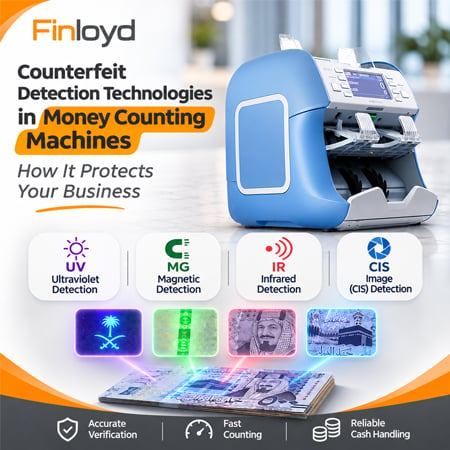
Quick answer: Money counters and fake note detectors check riyals with up to six kinds of sensor. UV checks how the paper and hidden features glow under ultraviolet light; MG reads magnetic ink; MT finds the metal security thread; IR checks how inks look under infrared; CIS scans the note’s image; and US (ultrasonic) measures thickness to catch taped or stuck notes. Each one catches a different kind of fake, and none catches everything, which is why good machines stack several. A basic UV detector such as the Fin-136 stops photocopies; value counters such as the CX-7500 combine five checks.
The six technologies at a glance
| Code | Name | What it checks | Catches | Can miss |
|---|---|---|---|---|
| UV | Ultraviolet | How the paper glows, and whether hidden UV features appear | Fakes on ordinary office paper, which glows bright blue | Fakes on special paper with copied UV features; genuine notes washed in detergent can fail |
| MG | Magnetic | Magnetic ink in set areas of the print | Inkjet and laser copies, which have no magnetic ink | Fakes printed with magnetic ink; very worn genuine notes can fail |
| MT | Metal thread | The metallic security thread inside the note | Fakes with a thread drawn or printed on | Fakes with a metal strip inserted |
| IR | Infrared | Which parts of the print show or disappear under infrared | Colour copies whose inks behave wrongly under infrared | High-quality fakes made with matching inks |
| CIS | Contact image sensor | An optical scan of the note’s image and size | Wrong designs, wrong denominations, size errors; allows serial number reading on some machines | Fakes that copy the image accurately but fail other checks |
| US | Ultrasonic | Note thickness | Taped, repaired or stuck-together notes | Not a counterfeit test on its own |
How each technology works
UV (ultraviolet)
Genuine banknote paper is made without the optical brighteners found in ordinary office paper, so it stays dull under ultraviolet light, while hidden fibres and printed features light up. A photocopy or inkjet print on office paper glows bright blue all over. That makes UV the cheapest and most useful first check, and the reason a basic UV lamp catches most crude fakes. Its weak spot: notes washed with detergent can pick up a glow and be rejected even though they are genuine.
MG (magnetic)
Parts of a genuine note are printed with ink that contains magnetic particles. A magnetic head reads where that ink is. Home printers and copiers cannot reproduce it, so MG catches most digital copies. It cannot tell a fake that was printed with magnetic ink, and heavily worn notes can lose some signal.
MT (metal thread)
Riyal notes carry a security thread embedded in the paper. A metal sensor checks that it is really there, rather than drawn or printed on the surface.
IR (infrared)
The inks on a genuine note are chosen so that some areas stay visible under infrared light and others disappear. Ordinary inks do not follow the same pattern, so a colour copy that looks perfect to the eye can fail the IR check.
CIS (contact image sensor)
A CIS is an optical scanner, like a small flatbed scanner, that the note passes over. The machine compares the image with the patterns it knows: that is how value counters recognise denominations and total mixed stacks, and how some read serial numbers. “Dual CIS” scans both sides.
US (ultrasonic)
An ultrasonic sensor measures thickness. It catches notes repaired with tape, notes stuck together and doubled notes. It is a quality check rather than a counterfeit check, but it stops a common trick: taping half a genuine note to half a fake.
Why stacking sensors works
Each sensor checks one physical property. A forger who beats one check, for example by using paper without brighteners to pass UV, still has to reproduce magnetic ink, the metal thread, the infrared pattern and the image. Every extra sensor makes a convincing fake harder and more expensive to produce. That is why bank-grade machines combine five or six checks, and why a counter with only UV is a starting point, not a final defence.
The software matters too: it decides what counts as a match. Keep your machine’s software updated, especially after SAMA issues a new note design.
Which Finloyd machines use which sensors
| Level | Model | Sensors | Best for |
|---|---|---|---|
| Hand detector | Fin-136 | UV | Quick checks at a till |
| Hand detector | FIN-140, fin-144 | UV and MG | Checking single notes and rejects more thoroughly |
| Sheet counter | Fin-890 | UV and MG | Counting sorted notes in shops and cafés |
| Value counter | CX-7500 | Dual CIS, UV, MG, MT, IR | Mixed tills, riyals, dollars and euros |
| Value counter | Fin-7900 | Dual CIS, UV, MG, IR, US | Busy counters, serial number records |
| 1+1 counter | Kisan K2 | CIS, UV, MG, IR, US | Head offices, non-stop counting with a reject pocket |
A counterfeit pen such as the Fin-83 only tests the paper and is the weakest check; use it as a backup, not as your main method.
What to do with a suspect note
- Do not hand it back to circulation or to the customer without checking.
- Check it by hand against the security features of Saudi banknotes published by the Saudi Central Bank (SAMA).
- Remember a reject is not proof: worn, damaged or washed genuine notes can fail a sensor.
- If you still suspect it is fake, keep it separate and follow your bank’s and the authorities’ procedure for reporting counterfeit currency.
Supply and service in Saudi Arabia
Finloyd has supplied fake note detectors and money counting machines in Saudi Arabia since 2008 and is the authorized distributor of Kisan counters in the Kingdom. Our teams in Riyadh, Jeddah and Al Khobar supply, install and update machines for new notes. See our fake note detectors and money counting machines.
Frequently asked questions
What does UV, MG and IR mean on a money counter?
UV is ultraviolet (checks how the paper glows), MG is magnetic (reads magnetic ink) and IR is infrared (checks how the inks look under infrared light). Many machines also have MT for the metal thread, CIS image sensors and US ultrasonic thickness sensors.
Which counterfeit detection technology is best?
No single one. Each catches different fakes. The strongest protection comes from combining several, such as UV, MG, MT, IR and CIS together.
Is UV enough to detect fake riyals?
UV catches fakes printed on ordinary paper, which covers most crude copies. Better fakes on special paper can pass UV, so add magnetic and image checks for cash-heavy businesses.
What is a CIS sensor in a money counter?
A contact image sensor: an optical scanner that reads the note’s image. It lets value counters recognise denominations, total mixed notes and, on some models, read serial numbers.
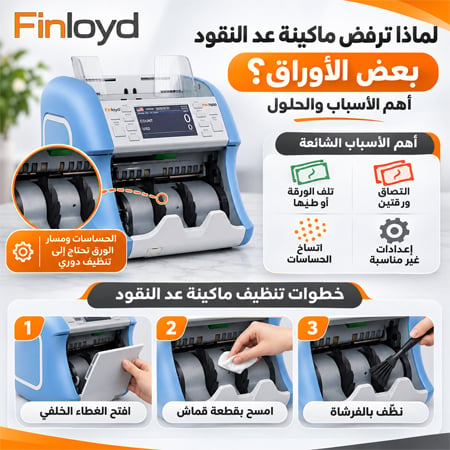
Why does my counter reject genuine notes?
Worn notes can lose magnetic signal, washed notes can glow under UV, and dirty sensors misread. Check the note by hand, clean the sensors and recount.
Is a counterfeit pen reliable?
It only tests the paper, so it is the weakest check. Use a UV or UV-and-magnetic detector instead.
Can any machine detect every fake?
No. Machines raise the bar by checking several features at once, but a reject means “check this note” and a pass is not a guarantee. Always check suspect notes by hand.
Where can I buy fake note detectors in Saudi Arabia?
Finloyd supplies UV and magnetic detectors and money counters with full sensor sets from Riyadh, Jeddah and Al Khobar. Call Jeddah +966 50 844 0075, Riyadh +966 50 003 2928 or Al Khobar +966 55 721 2191.
Not sure how much detection you need? Tell us how much cash you take and in which currencies, and we will recommend a detector or counter.