
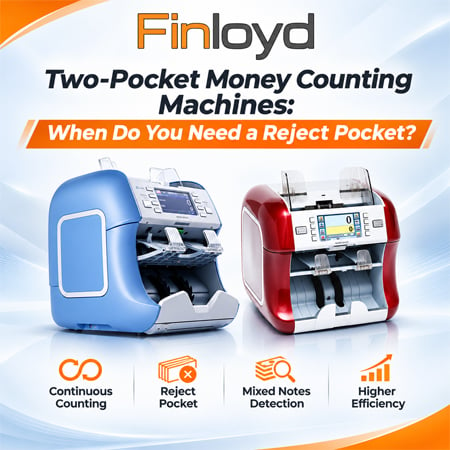
A two-pocket (1+1) money counting machine has a main stacker for accepted notes and a separate reject pocket for everything else, so it keeps counting instead of stopping. In Finloyd’s range, the Kisan K2, Newton-A and Newton 3F are 1+1 machines, and the K3-A, K5-A and K6 are multi-pocket sorters for banks and cash centres.
What is a two-pocket (1+1) money counter?
It is a money counter with two outputs. Notes that pass every check go to the main stacker. Notes that fail a check, or that you told the machine to separate, drop into a smaller reject pocket. “1+1” means one stacker plus one reject pocket. In Saudi Arabia it is also called a two-drawer counter (مكينة بدرجين).
What happens on a single-pocket machine when a note is rejected?
A single-pocket counter has only one place to put notes, so when it finds a suspect note, a different denomination or a double feed, it stops and sounds an alarm. The operator pulls the note out of the stack, then continues or re-counts the bundle. On pre-sorted bundles that is rare and quick. On mixed cash from a busy till, it can mean several stops per bundle and a higher chance of a note going back into the wrong pile.
What goes into the reject pocket?
Depending on the mode you choose, a 1+1 machine sends these notes to the reject pocket while the count continues:
- Suspected counterfeits flagged by the UV, MG, IR, CIS or ultrasonic sensors
- A different denomination, when you are counting one denomination only
- A different currency, when you are counting Saudi riyals only
- Double notes, chained notes and notes the machine cannot read
- Dog-eared notes, on the Newton-A, which has dog-ear detection
Only the notes in the main stacker are added to the total, so the figure on the display is clean.
Which Finloyd money counters have a reject pocket?
All figures below come from the spec table on each product page.
| Model | Pockets | Hopper (notes) | Reject pocket (notes) | Currencies | Best for |
|---|---|---|---|---|---|
| Fin-3100 | 1 | 300 | None | Saudi riyal (sheet counting) | Pre-sorted bundles |
| Fin-7900 | 1 | 500 | None | 10 | Mixed tills at lower volumes |
| Kisan K2 | 1+1 | 600 | 50 | 12 | Exchange houses, busy retail tills |
| Newton-A | 1+1 | 600 | 100 | 20 | Retail chains, hotels, foreign notes |
| Newton 3F | 1+1 | 600 | 100 | Up to 45 | Banks and cash centres |
| K3-A | 3 | 1,000 | 200 | Up to 48 | Bank branches, cash centres |
| K5-A | 4+1 | 1,000 | 100 | Up to 48 | Sorting by denomination |
| K6 | 4+2, with strapper | 1,000 | 100 + 200 | All denominations | Central cash processing |
When is a single pocket enough?
If your cash arrives as bank bundles or pre-sorted stacks, a single-pocket counter does the job, because rejections are rare. The Fin-890 and Fin-3100 count and check sorted riyal bundles quickly. For mixed takings at lower volumes, such as one or two tills a day, the Fin-7900 counts value with a dual CIS sensor and reads serial numbers in a compact single-pocket body.
When do you need a 1+1 machine, and when a multi-pocket sorter?
Choose a 1+1 machine when your cash is mixed and every stop costs time. Choose a multi-pocket sorter when you need notes split by denomination or fitness, not just counted.
- Kisan K2: exchange houses and busy retail tills. 12 currencies, serial-number reading, 50-note reject pocket.
- Newton-A: supermarkets, hotels and multi-branch retailers that take foreign notes. 20 currencies, 100-note reject pocket, dog-ear detection.
- Newton 3F: banks and cash centres that need fitness sorting and up to 45 currencies on a desktop 1+1.
- K3-A and K5-A: sort mixed cash into separate pockets by denomination, face and orientation in one pass, with fitness sorting and 1,000-note hoppers.
- K6: sorts and bands notes automatically, up to 8 straps per minute, for central cash processing.
What should you do with rejected notes?
- Take the notes out of the reject pocket before you start the next bundle, so they don’t get mixed in.
- Re-run notes rejected for a double feed or a fold. They usually pass the second time.
- Keep any note flagged as a suspected counterfeit aside. Don’t give it back to the customer or put it back into circulation; hand it to your bank, which follows the Saudi Central Bank (SAMA) procedures for suspected counterfeit currency.
Frequently asked questions
What does 1+1 mean on a money counter?
One main stacker plus one reject pocket. The machine puts suspect, unreadable or unwanted notes in the reject pocket and keeps counting.
Is a two-pocket money counter faster?
Not on paper: the advertised speeds are similar. It saves time in practice because it doesn’t stop for every rejected note, so mixed cash goes through with fewer interruptions.
Which Finloyd money counters have two pockets?
The Kisan K2, Newton-A and Newton 3F are 1+1 machines. The K3-A (3 pockets), K5-A (4+1) and K6 (4+2 with strapper) are multi-pocket sorters.
Do I need a two-pocket machine for a small shop?
Usually not. If you count one till a day or pre-sorted bundles, a single-pocket counter such as the Fin-890, Fin-3100 or Fin-7900 is enough. Move to a 1+1 machine when stops start slowing down your end-of-day count.
Are notes in the reject pocket added to the total?
No. Only notes in the main stacker are counted in the total, so rejected notes stay out until you re-run or remove them.
Where can I buy a two-pocket money counter in Saudi Arabia?
Finloyd supplies the Kisan K2, Newton-A, Newton 3F, K3-A, K5-A and K6 with a 2-year warranty, installation and support from its branches in Riyadh, Jeddah and Al Khobar, with delivery across the Kingdom.
Not sure which pocket setup fits your cash? Request a quote from Finloyd and our team will recommend a model for your volume and currencies. Compare every model in our guide to the best money counting machine in Saudi Arabia, see all money counting machines, or read how exchange companies choose a money counter.