
Quick answer: Before you build a vault room in Saudi Arabia, decide four things: what you are protecting, the EN 1143-1 burglary-resistance grade your insurer or regulator requires, how the walls will be built (poured concrete or modular armoured panels), and what goes inside. For cash rooms, panic rooms and private strongrooms, a Grade I door such as the Valberg EVD 1 is usually enough. For jewellers, corporate cash vaults and high-value stock, the Grade V Valberg AVD 5 is the step up. Banks typically specify Grade VII or higher. Finloyd designs, supplies and builds the complete vault room in Riyadh, Jeddah and Al Khobar.
A vault door is only as strong as the room around it. The most common mistake is buying a heavy door first and thinking about the walls, floor and ceiling later. Start with the risk, then the grade, then the room, and choose the door last.
1. Start with what you are protecting
| Use | What matters most | Typical starting grade |
|---|---|---|
| Home strongroom or panic room | Fast locking from inside, emergency release, discreet location | Grade I |
| Office cash room or records room | Controlled access, audit trail, fire and humidity control | Grade I |
| Gun room or armoury | Certified door, racking, access log | Grade I and above |
| Jewellery and bullion stock | Higher resistance, insurer approval, time-delay locks | Grade V and above |
| Corporate cash vault, cash-in-transit hub | Higher resistance, dual control, alarm integration | Grade V and above |
| Bank vault, safe deposit room | Regulatory and insurer grade, emergency door, deposit compartments | Grade VII and above |
Your insurer has the final say. Ask them which EN 1143-1 grade they require for the value you will store before you design anything.
2. Understand EN 1143-1 grades
EN 1143-1 is the European standard for burglary-resistant safes, strongroom doors and strongrooms. A certified product has been attacked in a laboratory with hand tools, power tools and cutting equipment, and given a grade according to how much resistance it showed. Higher grades resist longer and more powerful attacks. The grade is a tested result, not a description of how thick the steel looks, which is why insurers and banks ask for it by number.
The door and the room must be built to the same grade. A Grade V door set into an ordinary block wall gives you a Grade V door and an unprotected room.
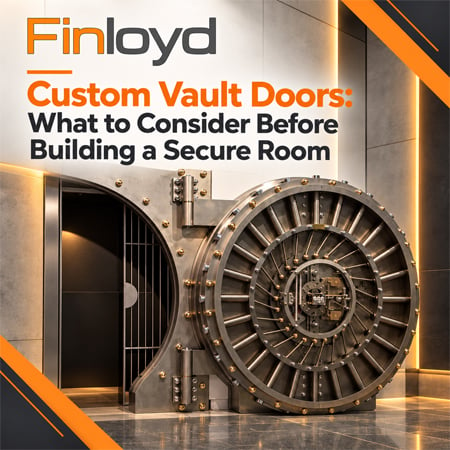
3. Choose the door: Valberg EVD 1 or AVD 5
| Spec | Valberg EVD 1 | Valberg AVD 5 |
|---|---|---|
| EN 1143-1 grade | Grade I | Grade V |
| Made in | Bulgaria | Bulgaria |
| Size | 2,000 × 900 mm free clearance | 2,019 × 1,227 × 240 mm external |
| Weight | About 188–204 kg | 800 kg |
| Locks | Electronic lock plus Class I/A key lock (EL+KL) | 2 × Class B as standard; key, mechanical or electronic |
| Electronic lock functions | Dual code, time delay, opening window, wrong-code lockout | Dual code, time delay, opening window, error-code blocking |
| Hinges and opening | External hinges, opens outward up to 180° | Internal hinges, opens 180° |
| Mounting | Anchoring bolts into reinforced concrete | Installed in concrete walls |
| Emergency option | Internal emergency release on request | Optional emergency door |
| Best for | Cash rooms, panic rooms, gun rooms, document vaults | Jewellers, corporate cash vaults, bank reserves, art |
For bank vaults that need Grade VII or higher, Finloyd scopes the door with the room as a single project. Projects under US-influenced tenders can also be offered with doors certified to UL 608, UL 887 and UL 768.
4. Decide how the walls will be built
- Poured reinforced concrete: the traditional method, best for new buildings and ground floors. It takes longer because the concrete must cure.
- Modular armoured panels: certified wall, floor and ceiling panels assembled on site. They suit upper floors, existing bank branches and retrofits, and can typically be installed in days without structural demolition.
Either way, the walls, floor and ceiling must match the door’s grade, and every penetration must be certified too.
5. Plan what goes into the room
- Emergency door: a second exit in the door or a wall panel. Required at Grade VII and above in financial installations.
- Security grille: an inner gate so the vault door can stand open during working hours while access stays controlled.
- Ventilation grilles and cable grommets: certified openings for air, alarm and power cables that keep the room’s grade intact.
- Interior fit-out: shelving and racking, cash drawers, lockers and safe deposit boxes, lighting, and climate and humidity control, which matters for documents and art in coastal cities such as Jeddah and Al Khobar.
- Detection: intrusion alarm, CCTV and biometric or card access control on the approach.
For a full list of certified parts, see our strong room components guide.
6. How a Finloyd vault room project runs
- Site assessment: our team surveys the space, structure, floor load and access route in Riyadh, Jeddah or Al Khobar.
- Grade and component scoping: we recommend the EN 1143-1 grade and components your risk and insurer require.
- Design and quotation: one project quote covering door, walls or panels, and all components.
- Fabrication and installation: poured-concrete or modular build, door fitting and lock commissioning by our technical team.
- Handover and documentation: certification paperwork for your insurer and compliance file, plus staff training.
Common mistakes to avoid
- Buying the door before checking the floor can carry it: the AVD 5 alone weighs 800 kg.
- Fitting a high-grade door into a wall that has no rating.
- Running cables or air ducts through the wall without certified penetrations.
- Forgetting an emergency release for anyone accidentally locked inside.
- Not asking the insurer which grade they require until after the build.
Frequently asked questions
What is the difference between a walk-in safe and a vault room?
The terms are largely interchangeable: both describe a room-sized, certified enclosure rather than a free-standing safe. “Vault room” is more common for banks and institutions, “walk-in safe” for retail and homes.
What grade of vault door do I need?
It depends on what you store and what your insurer requires. Grade I (such as the Valberg EVD 1) suits cash rooms and panic rooms; Grade V (such as the Valberg AVD 5) suits jewellers and corporate cash vaults; banks typically specify Grade VII or higher.
What is EN 1143-1?
The European standard for burglary-resistant safes, strongroom doors and strongrooms. Products are attack-tested in a laboratory and graded by the resistance they show; higher grades resist stronger attacks.
How much does a vault door weigh?
The Valberg EVD 1 weighs about 188–204 kg and the Grade V Valberg AVD 5 weighs 800 kg. The floor must be checked before installation.
Can an existing room be converted into a vault room?
Yes. Modular armoured panels can bring an existing room up to a certified grade without structural demolition, which is common for upper-floor offices and existing bank branches.
How long does it take to build a vault room?
Modular panel rooms can typically be completed in days. Poured-concrete rooms take longer because the concrete must cure. Finloyd advises on the right method at the site assessment.
Does a vault room need an emergency exit?
An emergency door is required at Grade VII and above in financial installations. For lower grades, an internal emergency release is strongly recommended and available on the EVD 1 on request.
Who builds vault rooms in Saudi Arabia?
Finloyd designs, supplies and installs complete vault rooms with certified Valberg doors in Riyadh, Jeddah and Al Khobar. Call Jeddah +966 50 844 0075, Riyadh +966 50 003 2928 or Al Khobar +966 55 721 2191.
Planning a vault room? Send us the room size, what you will store and your insurer’s requirements, and we will arrange a site assessment. See walk-in safes and custom vault rooms · See all vault doors