
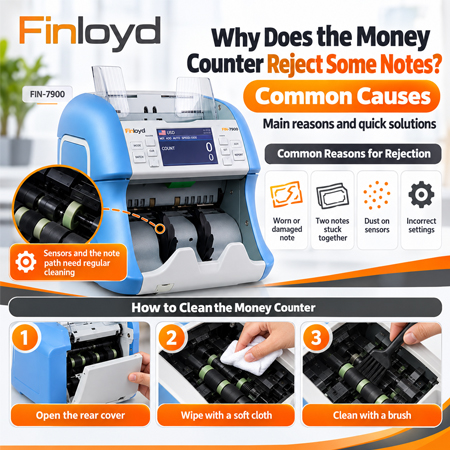
Short answer: Most rejections are not counterfeits. A money counting machine rejects a banknote when it cannot read it with confidence: the note is worn, taped or stuck to another note, the sensors or rollers need cleaning, the counting mode or currency setting doesn’t match the cash, or (on fitness sorters) the note is genuine but unfit for re-circulation. In cash operations, the aim is not zero rejections. It is the right rejections, so that real suspect notes are caught while genuine notes keep moving.
First, read what the machine is telling you
Before changing anything, check the display. Professional counters report three different outcomes, and each needs a different response:
- Read error / reject: the machine could not identify the note (damage, skew, double feed, dust). Usually an operator or cleaning issue.
- Suspect / counterfeit alarm: the note failed a security test: UV, magnetic (MG), infrared (IR), metallic thread (MT) or image (CIS). Follow your cash-handling procedure for suspect notes.
- Unfit note (fitness sorters only): the note is genuine but soiled, torn, taped or dog-eared beyond your fitness threshold. This is a sorting result, not a fault.
Causes and fixes, by where the problem sits
The banknotes
- Worn, taped, torn or heavily folded notes. These change the note’s length, thickness or image. Flatten them and recount. If a note keeps being rejected, process it manually.
- New notes stuck together. Fresh bank stock often double-feeds. Fan the bundle and square the edges before loading.
- Loose and bundled notes mixed together, or crumpled edges. Load clean, squared stacks, long edge first, within the hopper’s rated capacity.
The machine
- Dust on UV, MG, IR and CIS sensors. This is the most common cause of a sudden rise in rejections. Power off, unplug, and clean the sensors and note path with a soft dry brush. Never use liquid sprays.
- Worn or glazed feed rollers. On machines in heavy daily use, hardened rollers cause skew, chain feeds and rejects. Clean them first. If rejections persist, have the rollers inspected or replaced.
- Strong direct light. Sunlight or bright lamps directly on the machine can interfere with optical and UV sensing. Reposition the counter.
The settings
- Single-denomination mode on mixed cash. The machine stops at the first different denomination by design. Use mixed (MIX) mode for unsorted cash on value counters such as the CountExpress CX-7500, Fin-7900 or Kisan Newton-A.
- Currency or series not loaded. A machine only recognises the currencies and note series in its firmware. Foreign notes, or a new issue of the Saudi riyal, may be rejected until the currency data is updated.
- Detection sensitivity set too high. Reset to the factory default and re-test with known genuine notes. Never lower sensitivity just to silence alarms on notes you are unsure about.
- Fitness threshold too strict (sorters). On fitness sorters such as the Kisan K3-A and Kisan K5-A, a strict fitness level sends more genuine notes to the reject pocket. Set it to match your bank’s or cash centre’s re-circulation policy.
Quick diagnosis table
| Symptom | Likely cause | First action |
|---|---|---|
| Rejections rose suddenly across all notes | Dusty sensors | Unplug and brush-clean sensors and path |
| The same few notes rejected every pass | Damaged notes | Process manually |
| “Double” or “chain” errors on new notes | Notes sticking | Fan and square the bundle |
| Stops at every denomination change | Single-denomination mode | Switch to MIX |
| Rejects one currency or a new note series | Currency data not loaded | Request a currency update |
| Many genuine notes in the reject pocket of a sorter | Fitness threshold too strict | Review fitness settings |
| Skewed notes and jams on an older machine | Worn rollers | Clean rollers; book an inspection |
Why the reject pocket matters for high-volume cash
On single-pocket counters such as the Fin-890 and Fin-3100, every rejection stops the batch so the operator can remove the note. That is fine for a shop counting sorted cash. For tellers and exchange counters, a two-pocket machine such as the Kisan Newton 3F or Kisan K2 diverts rejected and suspect notes to a separate pocket, so counting continues without interruption. Cash centres that sort and band large volumes step up to multi-pocket sorters (K3-A, K5-A) and the Kisan K6 sorting and banding system.
Operator habits that cut rejections
- Brush the sensors and note path at the end of every day in high-volume branches, and at least weekly elsewhere.
- Keep a small set of known genuine test notes to check the machine after cleaning or setting changes.
- Record rejection counts per shift. A steady rise is an early sign of sensor dirt or roller wear.
- Keep the machine off sunny counters and away from dust sources such as doors and AC vents.
When to call Finloyd
Contact our technical team if rejections continue after cleaning, the machine shows a hardware error code, rollers are visibly worn, or you need currency data updated. Please don’t open a machine that is under warranty. Share the model, the serial number and a photo of the error message, and call your nearest branch:
- Jeddah: +966 50 844 0075
- Riyadh: +966 50 003 2928
- Al Khobar: +966 55 721 2191
Looking to replace or add a machine? Browse our money counting machines or request a quote for your branch volumes.
Frequently asked questions
Is a rejected banknote a counterfeit?
Usually not. Most rejected notes are genuine but worn, dirty, taped or stuck together. Counterfeit suspects trigger a separate alarm after failing a UV, MG, IR, MT or image check.
Why does a fitness sorter reject genuine notes?
Fitness sorters separate notes that are genuine but unfit for re-circulation, such as soiled, torn or taped notes. How many are rejected depends on the fitness level you set.
How often should a bank or exchange house clean its money counters?
Daily in high-volume branches, and at least weekly in lower-volume locations. Clean sooner if the rejection rate starts rising.
Can money counters be updated for new Saudi riyal notes?
Many professional models can have their currency data updated. Contact the supplier with the exact model and serial number to confirm.
Which machine is best if rejections keep stopping our tellers?
A two-pocket counter such as the Kisan Newton 3F or K2 sends rejected notes to a separate pocket, so the count continues without stopping.