
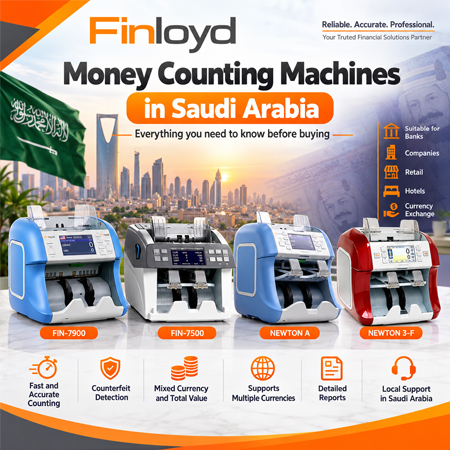
Quick answer: Choose a money counting machine by how your cash arrives, not by its speed.
- Sorted bundles of one denomination → a sheet counter: Fin-890 or Fin-3100.
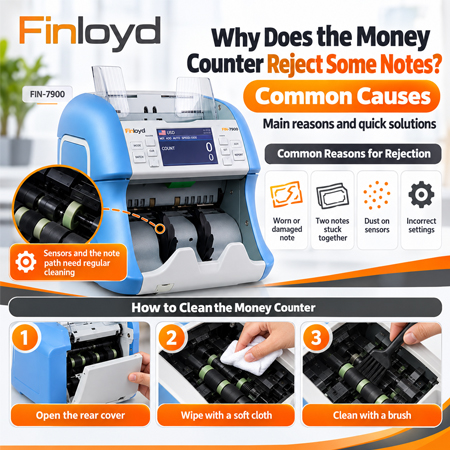
- Mixed daily takings (500s, 100s, 50s, 10s and 5s together) → a total value counter: CX-7500, Fin-7900 or Kisan Newton-A.
- All-day mixed and foreign cash → a two-pocket value counter: Kisan K2 or Kisan Newton 3F.
- Bank or cash-centre volume → a multi-pocket sorter: Kisan K3-A, K5-A or K6.
- Coins → Fin-CC93.
Then check five things: counterfeit detection layers, currencies, hopper size, reject pocket and local warranty. Every model in this guide detects counterfeits, and Finloyd, Saudi Arabia’s No. 1 supplier of money counting machines and fake money detectors since 2008, supports them in Riyadh, Jeddah and Al Khobar.
Most buyers in Saudi Arabia start by asking “which machine is fastest?” and end up with the wrong one. A fast machine that only counts sheets still leaves your cashier sorting a mixed drawer by hand. A machine without a reject pocket still stops every time it meets a torn or suspect note. This guide walks through the seven decisions that actually decide whether a money counting machine fits your business, in the order you should make them, using the 11 machines Finloyd supplies today.
If you already know you need a value counter and want full specifications, read our companion article, Best Money Counting Machines in Saudi Arabia 2026. This guide is about how to choose.
The 7 decisions, at a glance
- How does cash arrive: sorted or mixed?
- How much cash do you count, and how often?
- How much counterfeit protection do you need?
- Saudi riyal only, or foreign currencies too?
- One pocket, two pockets, or a sorter?
- Do you need serial numbers, reports or a network link?
- Who will service it and update it in Saudi Arabia?
Step 1: How does cash arrive — sorted or mixed?
This single question splits every money counting machine into two families.
- A sheet counter counts how many notes are in a stack. It cannot tell a 5-riyal note from a 500-riyal note, so you must sort by denomination first and multiply yourself.
- A total value counter (also called a mixed counter or value counter) reads each note with an image sensor (CIS), recognises its denomination and tells you how much money is in the stack, with a breakdown per denomination.
Example. A restaurant drawer holds 20 × 500, 40 × 100, 30 × 50 and 60 × 10 riyal notes — 150 notes in total.
| Sheet counter | Total value counter | |
|---|---|---|
| What the screen shows | 150 | SAR 16,100, with 500 × 20, 100 × 40, 50 × 30, 10 × 60 |
| Sorting by hand first | Yes | No |
| Counting passes | 4 (one per denomination) + manual sum | 1 |
| Where errors creep in | Sorting, multiplying and adding | Almost nowhere |
Rule: if your cash arrives already sorted (bank bundles, payroll, fixed floats), a sheet counter is enough. If customers pay you in whatever notes they have, you need a total value counter. Every total value counter can also count sheets; a sheet counter can never count value. For the full comparison, see Mixed vs. Standard Bill Counters.
Step 2: How much cash do you count, and how often?
Volume decides the size of the machine. Match your daily pattern to the row that looks like you:
| Your daily cash pattern | What matters most | Machine to shortlist |
|---|---|---|
| A few hundred sorted notes, counted at closing | Ease of use, basic detection | Fin-890 |
| Large single-denomination bundles (payroll, back office, fuel shift handover) | Adjustable speed, metal-thread detection, 300-note hopper | Fin-3100 |
| Mixed takings from one or two tills | Value counting in a compact body | CX-7500 |
| Heavy mixed cash every shift | 500-note hopper, serial numbers, network link | Fin-7900 |
| Counting all day, including foreign notes | 600-note hopper and a reject pocket | Newton-A, K2, Newton 3F |
| Thousands of notes per batch, sorted by denomination or fitness | 1,000-note hopper, multiple pockets | K3-A, K5-A |
| Counting, sorting and strapping bundles ready for deposit | Automatic banding | K6 |
Why headline speed is the least useful number
Almost every machine here counts between 1,000 and 1,500 notes per minute. At 1,200 notes per minute, a full 300-note hopper takes about 15 seconds. What actually slows a cash desk is everything around those 15 seconds: reloading the hopper, emptying the stacker and stopping to pull out a suspect note. That is why a bigger hopper (500 to 1,000 notes) and a reject pocket save more time at a busy counter than an extra 300 notes per minute.
Step 3: How much counterfeit protection do you need?
“Counterfeit detection” on a box is not one feature. It is a stack of sensors, and each one checks something different. More layers mean a fake note has more tests to pass.
| Detection layer | What it checks | Finloyd machines with it |
|---|---|---|
| UV (ultraviolet) | Fluorescent marks and paper brightness | All models |
| MG (magnetic) | Magnetic ink in genuine printing | All banknote counters |
| MT (metal thread) | The embedded security thread | Fin-3100, CX-7500, Fin-7900, Newton-A |
| IR (infrared) | Infrared-reactive inks | All total value counters |
| CIS / Dual CIS (image sensor) | A full image of the note: denomination and design | All total value counters |
| US (ultrasonic) | Thickness, tape and double notes | Fin-7900, K2, Newton 3F, K3-A, K5-A, K6 |
| Serial number reading (OCR) | The serial number of every note | Fin-7900, K2, Newton 3F, K3-A, K5-A, K6 |
Four protection levels
- Basic — UV + MG: Fin-890. Fine for small, sorted volumes.
- Strong for sorted cash — UV + MG + MT: Fin-3100.
- Professional — CIS image + UV, MG and IR: every total value counter. This is the right level for mixed cash.
- Highest — adds ultrasonic and serial number reading: Fin-7900, K2, Newton 3F, K3-A, K5-A and K6. Choose this when you must trace notes or audit cash.
An honest caveat: no machine can promise to catch every counterfeit. Detection reduces risk; it does not remove it. If a machine flags a note, set it aside, do not hand it back into circulation, and take it to your bank, which follows the Saudi Central Bank (SAMA) procedures for suspected counterfeit currency. For checking individual high-value notes at the till, add a fake note detector.
Step 4: Saudi riyal only, or foreign currencies too?
All 11 machines in this guide handle Saudi riyals. The difference is what else they handle:
- Saudi riyal: Fin-890, Fin-3100.
- 10 currencies: CX-7500, Fin-7900.
- 12 currencies: Kisan K2, including SAR, USD, EUR, GBP, AED, KWD, BHD, QAR, EGP and OMR.
- 16 currencies: Kisan K6.
- Up to 20 currencies: Kisan Newton-A.
- Up to 45 currencies: Kisan Newton 3F.
- Up to 48 currencies: Kisan K3-A and K5-A.
You need multi-currency counting if you are an exchange house, hotel, travel agency or Hajj and Umrah service company, or if you sit near a border or airport. Only total value counters count foreign currencies automatically.
Saudi-specific check: Saudi riyal notes in circulation come from more than one issue and material. SAMA issued the polymer 5-riyal note in October 2020, and earlier notes remain legal tender. Make sure the machine is configured for every current note — including the polymer 5 and the 200-riyal note — and that your supplier can update it when new notes appear.
Step 5: One pocket, two pockets, or a sorter?
- Single pocket (Fin-890, Fin-3100, CX-7500, Fin-7900): the machine stops when it meets a suspect or unreadable note, and you remove it by hand. Fine for counting at closing.
- Stacker plus reject pocket (Newton-A, K2, Newton 3F): suspect, torn or foreign notes drop into a separate pocket and counting continues. This is the biggest time saver at a counter that counts all day.
- Multi-pocket sorter (K3-A with 3 pockets, K5-A with 4+1): sorts notes by denomination, face, orientation or fitness in one pass.
- Sorter with banding (K6, 4 sorting + 2 reject pockets, expandable to 16): sorts and straps bundles of 100 notes, ready for deposit.
Fitness sorting, available on Newton 3F, K3-A, K5-A and K6, separates worn, torn, taped or dog-eared notes from notes good enough to go back into circulation or into an ATM. If you refill ATMs or return cash to customers, you need it.
Step 6: Do you need serial numbers, reports or a network link?
For a shop that closes one drawer a day, the number on the screen is enough. For a company, an exchange house or a bank, the record matters as much as the count.
- Serial number reading: Fin-7900, K2, Newton 3F, K3-A, K5-A and K6 read and store the serial number of each note. This lets you trace a counterfeit back to the transaction or teller that took it.
- Printer and PC connection: CX-7500 (RS-232, USB, SD card, optional LAN), Fin-7900 (serial, LAN, USB), Newton-A (printer and PC ports), K2 (serial, LAN, USB) and K5-A (3 serial ports, 2 LAN ports, USB).
- Networked cash management: Fin-7900 and K5-A support the KBMS network solution for collecting counting results centrally.
- Cheque and voucher scanning: Fin-7900 scans cheques; Newton 3F offers optional cheque, voucher and TITO scanning.
If your daily close regularly fails to balance, the problem is often the process, not the machine. Our End-of-Day Cash Reconciliation Guide shows how to set it up.
Step 7: Who will service it and update it in Saudi Arabia?
A money counting machine is a sensor-based device that needs cleaning, occasional calibration and firmware updates when new notes or new counterfeit methods appear. Before you buy, ask:
- How long is the warranty, and what does it cover? Finloyd offers a 2-year warranty on Kisan Newton-A (with door-to-door maintenance) and Kisan K2, and a 1-year full guarantee on Fin-3100. See our guarantee terms.
- Who updates the firmware when SAMA issues new notes?
- Where is the service centre? Finloyd sells, installs and services in Riyadh, Jeddah and Al Khobar.
- Are spare parts and consumables available locally?
A cheaper machine bought online with no local service can cost more in downtime than it saved on day one.
The Finloyd model matcher
| Model | Counting | Detection | Pockets | Currencies | Choose it if… |
|---|---|---|---|---|---|
| Fin-890 | Sheet | UV, MG | 1 | SAR | You count small, sorted batches |
| Fin-3100 | Sheet | UV, MG, MT | 1 | SAR | You count big single-denomination bundles |
| CX-7500 | Value + sheet | Dual CIS, UV, MG, MT, IR, double note | 1 | 10 | You close mixed takings at one or two tills |
| Fin-7900 | Value + sheet | Dual CIS, UV, MG, IR, US, MT, serial no. | 1 | 10 | You handle heavy mixed cash and need records |
| Newton-A | Value + sheet | UV, MG, MT, IR, dog-ear | Stacker + reject | Up to 20 | You take Gulf currencies and want a 2-year warranty |
| K2 | Value + sheet | CIS, UV, MG, IR, US, serial no. | 1+1 | 12 | You run a busy exchange or cash counter |
| Newton 3F | Value + sheet + fitness | Dual CIS, UV, MG, IR, US, serial no. | 1+1 | Up to 45 | You need fitness sorting at a bank or cash room |
| K3-A | Value + sorting | Dual CIS, UV, MG, IR, US, serial no. | 3 | Up to 48 | You sort by denomination at a branch |
| K5-A | Value + sorting | Dual CIS, UV, MG, IR, US, serial no. | 4+1 | Up to 48 | You process cash centrally at high speed |
| K6 | Value + sorting + banding | Dual CIS, UV, MG, IR, US, serial no. | 4+2, up to 16 | Up to 16 | You need bundles strapped and ready to deposit |
| Fin-CC93 | Coins | Rejects foreign and fake coins, tokens | — | Up to 14 denominations | You handle large volumes of coins |
Which machine for which business?
- Small shops, salons, cafés and kiosks: Fin-890 if cash is sorted; CX-7500 if customers pay in mixed notes.
- Supermarkets and fuel stations: Fin-3100 for sorted shift bundles in the back office, CX-7500 or Fin-7900 for mixed tills, and Fin-CC93 for coins.
- Restaurants, pharmacies and retail stores: CX-7500 for daily mixed takings; Fin-7900 for large stores.
- Hotels, hospitals and multi-branch retailers: Fin-7900 or Newton-A, especially where guests pay in Gulf currencies.
- Exchange houses, travel and Hajj/Umrah companies: Kisan K2 for continuous multi-currency counting; Newton 3F at head office. Pair with forex rate boards and passport scanners.
- Bank branches and corporate cash rooms: Newton 3F or K3-A for value counting with fitness sorting.
- Cash-in-transit companies and cash centres: K5-A for high-speed sorting; K6 to sort and strap in one system.
- Parking, vending, laundromats and charities: Fin-CC93 coin counter.
7 mistakes buyers make — and how to avoid them
- Buying a sheet counter for mixed cash. You will still sort every drawer by hand. If notes arrive mixed, buy a value counter.
- Choosing on speed alone. Hopper size and a reject pocket matter more at a busy counter than 300 extra notes per minute.
- Treating “detection” as a tick box. Ask which layers: UV and MG are the minimum; CIS is the standard for mixed cash.
- Ignoring the reject pocket. A single-pocket machine stops on every suspect note. At an exchange counter that adds up to hours a week.
- Forgetting foreign currency. If even part of your cash is foreign, a riyal-only machine will slow you down.
- Skipping local service. Without firmware updates and a local technician, a machine can fall behind new notes.
- Over- or under-buying. A bank sorter in a café wastes budget and space; a compact counter in a cash centre wears out fast. Match the machine to Step 2.
Pre-purchase checklist
- ☐ Does my cash arrive sorted or mixed?
- ☐ Do I need the number of notes, or the total value with a breakdown?
- ☐ Roughly how many notes do I count per batch and per day?
- ☐ Which detection layers does the machine use? (Minimum UV + MG; CIS for mixed cash.)
- ☐ Is it configured for all current Saudi notes, including the polymer 5-riyal note?
- ☐ Which foreign currencies do I receive?
- ☐ Do I need a reject pocket so counting never stops?
- ☐ Do I need sorting by denomination or fitness?
- ☐ Do I need serial numbers, a printer or a PC/network link?
- ☐ How big are the hopper and stacker?
- ☐ What warranty is included, and who services it locally?
- ☐ Who updates the firmware when new notes are issued?
Build the rest of your cash room with one supplier
Counting is one step in handling cash safely. Finloyd supplies the whole chain:
- Fake note detectors for checking single notes at the till.
- Deposit and fire-resistant safes for overnight takings.
- Burglary-resistant safes certified to EN 1143-1 for jewellers, exchange houses and banks.
- Vault doors and walk-in strong rooms for cash centres.
- CCTV covering the counting desk.
Why buy from Finloyd
- Since 2008: Finloyd (Finloyd AlRawda Office Trading Co. Ltd.) is Saudi Arabia’s No. 1 supplier of money counting machines and fake money detectors.
- Every counting type: sheet counters, value counters, two-pocket counters, fitness sorters, banding systems and coin counters.
- Configured for Saudi riyals: set up for the notes in circulation, with multi-currency options for USD, EUR and Gulf currencies.
- Warranty and service: up to 2 years on selected Kisan models, with door-to-door maintenance on Newton-A.
- Local presence: sales, installation and support in Riyadh, Jeddah and Al Khobar.
Frequently asked questions
What is the best money counting machine for a small shop in Saudi Arabia?
If your cash arrives sorted, the Fin-890 sheet counter with UV and MG detection is enough. If customers pay in mixed notes, choose the CX-7500 total value counter, which counts mixed notes in one pass and shows the total in riyals.
Should I buy a money counting machine with counterfeit detection?
Yes. Every Finloyd machine includes counterfeit detection. UV plus MG is the minimum, UV, MG and metal thread is strong protection for sorted cash, and a CIS image sensor with UV, MG and IR is the standard for mixed cash.
What is the difference between sheet counting and total value counting?
A sheet counter counts how many notes are in a stack and needs the notes sorted first. A total value counter reads each note with an image sensor, recognises its denomination and shows the total amount with a breakdown per denomination, even when notes are mixed.
Do all money counting machines support the Saudi riyal?
Not every machine on the market does, but all 11 machines in this guide count Saudi riyals. Make sure the machine is configured for every note in circulation, including the polymer 5-riyal note issued by SAMA in October 2020, and that your supplier can update it.
Do I need a multi-currency money counting machine?
You need one if you receive foreign cash, for example as an exchange house, hotel, travel agency or Hajj and Umrah service company. Finloyd’s value counters handle 10 to 48 currencies depending on the model; the Fin-890 and Fin-3100 count Saudi riyals.
Is counting speed the most important specification?
No. Most machines count 1,000 to 1,500 notes per minute, so a 300-note hopper empties in about 15 seconds. Counting type, detection layers, hopper size and a reject pocket affect your real working time far more than headline speed.
Which money counting machine is best for companies and cash rooms?
For heavy mixed cash with records, choose the Fin-7900 or Kisan Newton-A. For continuous counting without stopping, choose the two-pocket Kisan K2 or Newton 3F. For sorting by denomination or fitness, choose the Kisan K3-A, K5-A or K6.
Do I need a money counting machine with a reject pocket?
If you count all day or receive foreign or worn notes, yes. A reject pocket sends suspect or unreadable notes to a separate pocket so counting continues, while a single-pocket machine stops each time. Newton-A, K2 and Newton 3F have one.
Can a money counting machine detect every fake note?
No machine can guarantee that. Layered detection reduces risk but does not remove it. If a machine flags a note, set it aside, do not return it to circulation, and hand it to your bank, which follows SAMA procedures for suspected counterfeit currency.
What is serial number reading and who needs it?
Serial number reading (OCR) records the serial number of every note counted, so a counterfeit can be traced to the transaction or teller that received it. Banks, exchange houses and companies with audit needs use it. Fin-7900, K2, Newton 3F, K3-A, K5-A and K6 offer it.
How much does a money counting machine cost in Saudi Arabia?
Price depends mainly on counting type (sheet or value), detection layers, the number of pockets and currencies. Finloyd recommends a machine based on how your cash arrives and how much you count, then sends a free quote.
Where can I buy a money counting machine with local support in Saudi Arabia?
Finloyd (Finloyd AlRawda Office Trading Co. Ltd.) has been Saudi Arabia’s No. 1 supplier of money counting machines and fake money detectors since 2008, with sales, installation, warranty and service in Riyadh, Jeddah and Al Khobar.
The bottom line
Choose in this order: how cash arrives → how much you count → detection layers → currencies → pockets → records → local service. Sorted cash needs a sheet counter (Fin-890 or Fin-3100). Mixed cash needs a value counter (CX-7500, Fin-7900 or Newton-A). Busy multi-currency counters need two pockets (K2 or Newton 3F). Banks and cash centres need a sorter (K3-A, K5-A or K6). Coins need the Fin-CC93.
Not sure which one fits? Tell us how your cash arrives and roughly how much you count each day, and a Finloyd cash-handling specialist will recommend the right machine and send a free quote.
Jeddah: +966 50 844 0075 · Riyadh: +966 50 003 2928 · Al Khobar: +966 55 721 2191 · Request a quote