
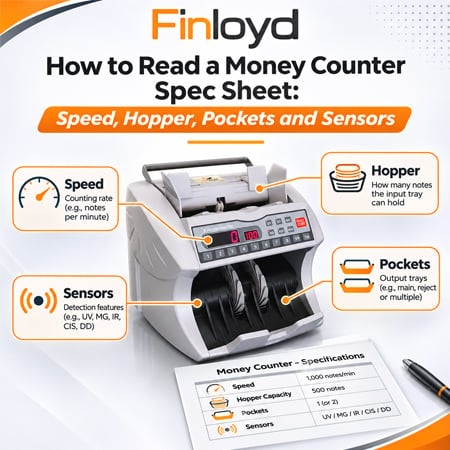
A money counter spec sheet tells you five things: how fast it counts in each mode, how many notes you can load and stack, how many pockets it has, which sensors check each note, and how it connects to a printer or PC. For most buyers the figures that matter are the value-count speed and the hopper capacity, not the headline free-count speed printed in large type.
Why does a spec sheet list three different speeds?
Because the machine does different amounts of work in each mode. Free count (or normal count) only counts notes, so it’s the fastest figure. Value count also recognises each note’s denomination. S/N speed is the speed while it also reads serial numbers. For example, the Fin-7900 counts 1,500 notes a minute in free count and 1,000 in value count, the CX-7500 counts 1,500 and 1,200, and the Kisan K2 counts 1,000 in value count and 800 while reading serial numbers. The Fin-3100 lets you set 900, 1,200 or 1,500 notes a minute.
In practice, the time you spend loading the hopper and emptying the stacker matters as much as the speed, which is why capacities come next.
What do hopper, stacker and reject capacity tell you?
The hopper is how many notes you can load at once, the stacker is how many counted notes it holds before you must empty it, and the reject capacity is how many suspect or odd notes it can set aside. Figures from the spec table on each product page.
| Model | Value count speed (notes/min) | Hopper | Stacker | Reject | Pockets |
|---|---|---|---|---|---|
| Fin-3100 | Sheet count only (up to 1,500) | 300 | 200 | – | 1 |
| CX-7500 | 1,200 | 300 | 200 | – | 1 |
| Fin-7900 | 1,000 | 500 | 200 | – | 1 |
| Kisan K2 | 1,000 | 600 | 200 | 50 | 1+1 |
| Newton-A | Not listed | 600 | 200 | 100 | 1+1 |
| Newton 3F | 1,200 | 600 | 200 | 100 | 1+1 |
| K3-A | 1,000 | 1,000 | 200 | 200 | 3 |
| K5-A | 1,000 | 1,000 | 200 | 100 | 4+1 |
| K6 | 1,000 | 1,000 | 500 | 100 + 200 | 4+2 |
A simple rule: pick a hopper that holds your usual stack in one go. If you count 500-note stacks, a 300-note hopper means loading every stack twice.
How many pockets do you need?
One pocket is fine for sorted notes. A reject pocket (1+1) lets the machine set aside suspect notes or other denominations without stopping, which saves a lot of time on mixed cash. Three or more pockets turn the machine into a sorter that splits notes by denomination, orientation or fitness. Our two-pocket money counter guide explains when the reject pocket pays off.
Which sensors should be on the list?
For counterfeit detection, look for at least UV and MG. Value counters add a CIS image sensor, and better models add IR, a metal-thread (MT) check and ultrasonic (US) thickness sensing for double and taped notes. Channel numbers show coverage: MG(18ch) means 18 magnetic channels across the note, and US(21ch) on the K3-A means 21 ultrasonic channels. Dual CIS scans both sides of the note. Every code is explained in our money counter glossary.
What about the screen, ports and currencies?
- Screen: 3.5″ touch display on the CX-7500, 4.3″ touch on the Fin-7900, Kisan K2 and Newton 3F, and 7″ touch on the K3-A, K5-A and K6. A bigger screen makes denomination breakdowns and serial numbers easier to read.
- Ports: USB, LAN and serial ports decide whether you can print or export counts. See our guide to money counter reports, printers and KBMS.
- Currencies: the number of currencies the machine recognises, from 5 on the CX-7500 to up to 48 on the K3-A and K5-A. See our multi-currency money counter guide.
Spec sheet checklist before you request a quote
- Value-count speed against your busiest day, not the free-count figure.
- A hopper that takes your usual stack in one load.
- A reject pocket if you count mixed or unchecked cash.
- UV and MG as a minimum; CIS, IR and US if you take large amounts from the public.
- Every currency you handle, plus room for one or two more.
- Ports for printing or PC export if you need a record.
- Warranty and local service: Finloyd gives a 2-year warranty and door-to-door support from Riyadh, Jeddah and Al Khobar.
Frequently asked questions
What is the difference between free count speed and value count speed?
Free count speed is how fast the machine counts notes without recognising their denomination. Value count speed is how fast it counts while identifying each denomination and adding up the total. Value count is usually slower: the Fin-7900 does 1,500 and 1,000 notes a minute respectively.
Is a faster money counter always better?
No. Above about 1,000 notes a minute, loading and unloading take more time than counting. Hopper size, a reject pocket and reliable detection often save more time than extra speed.
What hopper capacity do I need?
Enough to load your usual stack in one go. Finloyd models range from 300 notes on the Fin-3100 and CX-7500 to 600 on the Kisan K2, Newton-A and Newton 3F, and 1,000 on the K3-A, K5-A and K6.
What do MG(18ch) and US(21ch) mean on a spec sheet?
They give the number of sensor channels. MG(18ch) is a magnetic sensor with 18 channels across the note, and US(21ch) is an ultrasonic sensor with 21 channels. More channels check more of the note’s surface.
What is a reject pocket for?
It takes suspect notes, damaged notes or notes of another denomination out of the count so the machine keeps running. The Kisan K2, Newton-A and Newton 3F have a 1+1 layout with a reject pocket.
Which Finloyd money counter has the largest hopper?
The K3-A, K5-A and K6, which each take 1,000 notes. The K6 also has the largest stacker, at 500 notes, and two reject pockets.
Want us to read the spec sheets for you? Request a quote from Finloyd, tell us how much cash you count and how, and we’ll recommend the right model. Compare all models in our guide to the best money counting machine in Saudi Arabia, or browse all money counting machines.