
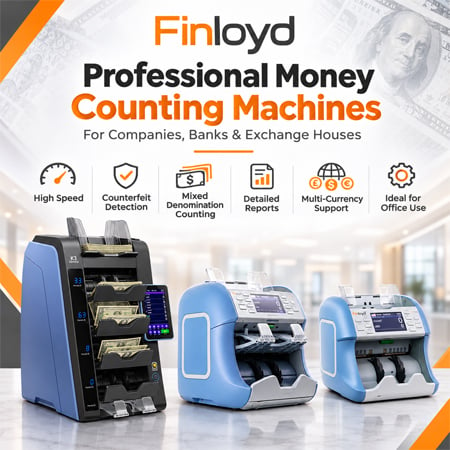
Quick answer: For Saudi banks and exchange houses, the choice is between two classes of machine. Two-pocket (1+1) machines, the Glory GFS-220F, Hitachi iH-110 and Kisan K2, count and authenticate continuously, setting suspect notes aside in a reject pocket. They suit teller desks and exchange counters. Multi-pocket sorters, the Kisan K5-A (4+1) and Kisan K6, sort by denomination, fitness and facing in one pass, for branch back offices and cash centres. Among the 1+1 machines, choose Glory or Hitachi for fitness sorting and up to 40 currencies, or the K2 for 10 currencies at a lower cost.
Specifications side by side
| Spec | Glory GFS-220F | Hitachi iH-110 | Kisan K2 | Kisan K5-A | Kisan K6 |
|---|---|---|---|---|---|
| Class | 1+1 | 1+1 | 1+1 | 4+1 sorter | Modular sorter |
| Hopper | 500 notes (1,000 with extension) | 500 notes (1,000 on fitness version) | 600 notes | 1,000 notes | 1,500 notes |
| Stacker | 200 | 200 (up to 300) | – | 200 per pocket | 500 |
| Reject pocket | 100 | 60 (up to 100) | Yes | 100 | Two reject pockets |
| Top speed | 1,300 piece, 1,200 value, 1,000 fitness (notes/min) | Up to 1,300 value (notes/min) | 1,000 value (notes/min) | – | – |
| Currencies | Up to 40 | Up to 40 installed, 16 in mixed mode | 10 | Up to 48 | – |
| Fitness sorting | Yes (F model) | Yes (fitness versions) | No | Yes | Yes |
| Serial number reading | Yes | Yes | Yes | Yes | – |
| Strapping | – | – | – | – | Optional module |
| Best for | Bank tellers, exchange houses needing fitness | Bank tellers, exchange houses, multi-currency | Exchange counters, head offices | Branch back offices, cash-in-transit | Bank cash centres |
Figures from Glory’s and Kisan’s published specifications and Finloyd product pages; exact configurations vary by version. A dash means the figure is not published for the version Finloyd supplies.
1+1 machine or multi-pocket sorter?
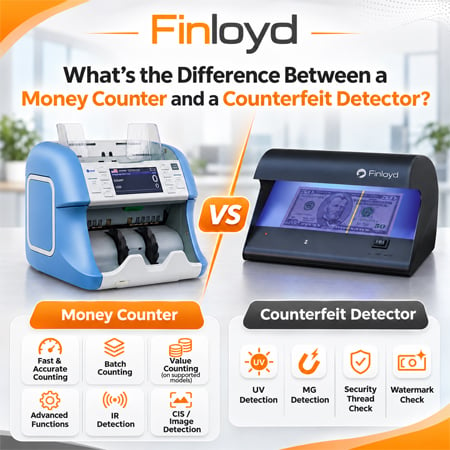
A 1+1 machine has one stacker and one reject pocket. It counts and authenticates without stopping, sending suspect, foreign or (on fitness models) unfit notes to the reject pocket. To separate denominations it needs one pass per denomination, or a mixed count that totals the value.
A multi-pocket sorter has several stackers. In one pass it puts 500s in one pocket, 100s in another, unfit notes in a third, and so on, ready for strapping. That saves hours a day in a branch back office or cash centre, but costs much more and takes more desk space.
Rule of thumb: if the job is to count and check what customers hand over, choose a 1+1 machine. If the job is to prepare notes for the vault, the ATM or the central bank, choose a multi-pocket sorter.
Glory GFS-220F vs Hitachi iH-110
Both are compact two-pocket machines built for teller desks, with fitness sorting and serial number reading. The differences are small and come down to preference and configuration:
- Speed: Hitachi lists up to 1,300 notes per minute in value counting; Glory lists 1,200 for value counting and 1,300 for piece counting.
- Hopper: both take 500 notes as standard; Glory with an extension and Hitachi on its fitness version reach 1,000.
- Currencies: both handle up to 40 currencies; Hitachi specifies 16 in mixed mode.
- Imaging: Hitachi uses full-colour dual CIS imaging; Glory scans each note’s full surface.
Choose the one your tellers already know, or the one whose service and currency set best match your branch network.
When the Kisan K2 is enough
The Kisan K2 is also a 1+1 machine with a reject pocket and serial number reading, handling 10 currencies including SAR, USD, EUR and GCC currencies. It does not do fitness sorting. For an exchange counter or a head office counting branch bags, where the job is counting and catching suspect notes rather than sorting fit from unfit, it does the job at a fraction of the price of a Glory or Hitachi.
Which machine for which job?
| Job | Choose |
|---|---|
| Bank teller desk | Glory GFS-220F or Hitachi iH-110 |
| Exchange house counter, many currencies | Hitachi iH-110 or Glory GFS-220F |
| Exchange counter, SAR, USD, EUR and GCC only | Kisan K2 |
| Head office counting branch bags | Kisan K2 |
| Branch back office preparing notes for the ATM or vault | Kisan K5-A |
| Cash-in-transit depot | Kisan K5-A |
| Bank cash centre | Kisan K6 with strapping |
For smaller businesses, see our guide to professional money counting machines, which covers value counters from the CX-7500 upward.
What to ask before buying
- Currency set: which currencies are installed, and how many can run in mixed mode.
- Updates: how quickly the supplier updates software when SAMA or another central bank issues a new note.
- Fitness criteria: which defects the fitness model detects (soil, tears, tape, holes) and whether thresholds can be set.
- Service: local technicians, spare parts and response times in your cities.
- Reports: serial number logs and export to your core banking or cash management system.
To check suspect notes by hand, use the security features published by the Saudi Central Bank (SAMA).
Supply and service in Saudi Arabia
Finloyd has supplied money counting and sorting machines to banks, exchange houses and cash-heavy businesses in Saudi Arabia since 2008, and is the authorized distributor of Kisan counters and sorters in the Kingdom. Our technicians in Riyadh, Jeddah and Al Khobar install, configure currency sets, update software for new notes and provide maintenance. See all money counting machines.
Frequently asked questions
What is the best money counting machine for banks in Saudi Arabia?
For teller desks, a two-pocket fitness machine such as the Glory GFS-220F or Hitachi iH-110. For back offices and cash centres, a multi-pocket sorter such as the Kisan K5-A or K6.
What is the difference between the Glory GFS-220F and Hitachi iH-110?
Both are two-pocket machines with fitness sorting and serial number reading. Hitachi lists up to 1,300 notes per minute in value counting and 16 currencies in mixed mode; Glory lists 1,200 notes per minute in value counting and up to 40 currencies. Both take 500 notes, extendable to 1,000.
Is the Glory GFS-220F a multi-pocket sorter?
No. It has one stacker and one reject pocket (1+1). For sorting into several pockets in one pass, choose a multi-pocket sorter such as the Kisan K5-A.
What is a 1+1 money counter?
A machine with one stacker and one reject pocket that counts continuously, setting suspect or unfit notes aside instead of stopping.
Does the Kisan K2 do fitness sorting?
No. The K2 counts, authenticates and reads serial numbers for 10 currencies. For fitness sorting, choose the Glory GFS-220F, Hitachi iH-110 fitness version or Kisan K5-A.
What machine do exchange houses use?
Usually a two-pocket multi-currency machine: Hitachi iH-110 or Glory GFS-220F for many currencies, or Kisan K2 for SAR, USD, EUR and GCC currencies.
What is fitness sorting?
Checking each note’s condition and separating soiled, torn, taped or worn notes from notes fit to reissue, so banks can recirculate good notes and return unfit ones.
Where can I buy Glory, Hitachi or Kisan machines in Saudi Arabia?
Finloyd supplies, installs and services Glory, Hitachi and Kisan machines from Riyadh, Jeddah and Al Khobar. Call Jeddah +966 50 844 0075, Riyadh +966 50 003 2928 or Al Khobar +966 55 721 2191.
Equipping a branch or exchange house? Tell us your daily volume, currencies and whether you need fitness sorting, and we will recommend the machine and arrange a demonstration.