
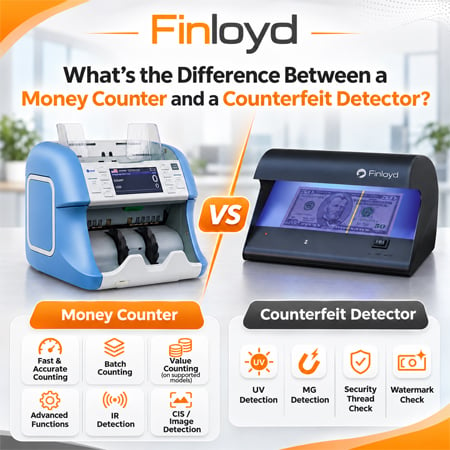
Quick answer: A fake note detector checks one note at a time, at the till, while the customer is still there. A money counter with detection checks every note in a stack, at closing, after the change has been given. If a fake reaches your counter, you have already lost the goods and the change. So most businesses that take cash need a detector at each till, such as the FIN-140, and a counter with detection in the back office, such as the Fin-890 or CX-7500. A very small shop can start with a detector alone; a back office that never takes cash from customers needs only the counter.
The difference in one table
| Fake note detector | Money counter with detection | |
|---|---|---|
| Main job | Check a single note | Count and check a stack |
| Where it sits | At the till or counter | In the back office or cash room |
| When it checks | When the customer pays | At shift change or closing |
| What a catch means | You refuse the note before giving goods or change | You find out after the loss |
| Counts notes? | No | Yes, and value counters total mixed notes |
| Finloyd models | Fin-136 (UV), FIN-140 and fin-144 (UV and magnetic) | Fin-890, CX-7500, Fin-7900, Kisan K2 |
Why timing matters more than features
Imagine a customer pays a SAR 100 bill with a SAR 500 note. If it is fake and you only check at closing, you have lost the goods and SAR 400 in change. A detector at the till, which takes a few seconds per note, lets the cashier refuse the note on the spot. The counter in the back office then acts as a second line: it checks every note again, catches anything the till missed, and gives you an accurate total.
Which detector at the till?
- Fin-136 (UV): shows whether the paper glows under ultraviolet light; catches copies printed on ordinary paper. Good for quick checks.
- FIN-140 or fin-144 (UV and magnetic): adds a magnetic ink check, which catches most home-printed fakes. The better choice for busy tills and large notes.
- Fin-83 pen: tests the paper only; useful as a backup, not as the main check.
For how each sensor works, see our guide to counterfeit detection technologies.
Which counter in the back office?
- Fin-890: UV and magnetic checks while counting sorted notes.
- CX-7500: five checks (UV, magnetic, metal thread, infrared and a two-sided image scan) while totalling mixed riyals, dollars and euros.
- Fin-7900 or Kisan K2: add an ultrasonic check for taped notes; the K2 sets suspect notes aside without stopping.
Setups by business
| Business | At the till | In the back office |
|---|---|---|
| Small shop, few large notes | Fin-136 UV detector | Not needed at first; add a Fin-890 as cash grows |
| Café or shop counting cash daily | FIN-140 | Fin-890 |
| Restaurant or pharmacy with mixed tills | FIN-140 at each till | CX-7500 |
| Supermarket with several tills | FIN-140 or fin-144 at every till | CX-7500 or Fin-7900 |
| Exchange counter | fin-144 at the counter | Kisan K2 |
| Head office counting branch bags (no customers) | Not needed | Kisan K2 |
For sector guides, see our posts on restaurants and pharmacies.
When one device is enough
- Detector only: a small shop with few cash sales, where you can count the day’s takings by hand.
- Counter only: a back office or head office that counts cash collected elsewhere and never serves customers.
- Both: any business where cashiers take cash from customers and someone counts the takings at closing. That is most shops, restaurants, pharmacies and supermarkets.
A caught note is not proof
Worn or washed genuine notes can fail a check, and no device catches every fake. If a note is rejected, check it by hand against the security features published by the Saudi Central Bank (SAMA), and train cashiers to refuse it politely rather than accuse the customer.
Supply and service in Saudi Arabia
Finloyd has supplied fake note detectors and money counting machines in Saudi Arabia since 2008 and is the authorized distributor of Kisan counters in the Kingdom. Our teams in Riyadh, Jeddah and Al Khobar recommend the right mix for your tills and back office, install, train staff and service machines. See all fake note detectors and money counting machines.
Frequently asked questions
What is the difference between a money counter and a counterfeit detector?
A counterfeit detector checks one note at a time, usually at the till when the customer pays. A money counter counts a stack and, if it has detection, checks every note, usually at closing in the back office.
Do I need a fake note detector if my money counter detects fakes?
Usually yes, if you take cash from customers. The counter checks notes at closing, after the change has been given; a detector at the till lets cashiers refuse a fake on the spot.
Can a money counter replace a fake note detector?
Only where no customer hands over cash, such as a head office counting branch bags. At a till, a detector is faster for single notes.
Which fake note detector is best for a shop till?
A UV and magnetic detector such as the FIN-140 or fin-144 for busy tills; a UV detector such as the Fin-136 for quick, occasional checks.
Which money counter has counterfeit detection?
The Fin-890 checks UV and magnetic features; the CX-7500 adds metal thread, infrared and image checks; the Fin-7900 and Kisan K2 add ultrasonic checks for taped notes.
Is a counterfeit pen enough?
No. A pen tests the paper only. Use it as a backup to a UV or UV-and-magnetic detector.
What should a cashier do with a suspect note?
Refuse it politely, check it against SAMA’s published security features, and follow your manager’s and bank’s procedure. A rejected note is not proof that it is fake.
Where can I buy fake note detectors and money counters in Saudi Arabia?
Finloyd supplies detectors and money counting machines from Riyadh, Jeddah and Al Khobar. Call Jeddah +966 50 844 0075, Riyadh +966 50 003 2928 or Al Khobar +966 55 721 2191.
Not sure what you need? Tell us how many tills you have and how you count at closing, and we will recommend the right mix.